Indonesia’s Energy Transition Remains Challenging After Two Years of Prabowo-Gibran
JAKARTA, JakartaWeekly.com—Energy sector performance during the first two years of President Prabowo Subianto and Vice President Gibran Rakabuming Raka’s administration is considered less than optimal. While several renewable energy policies have made progress, the national renewable energy mix target remains unmet.
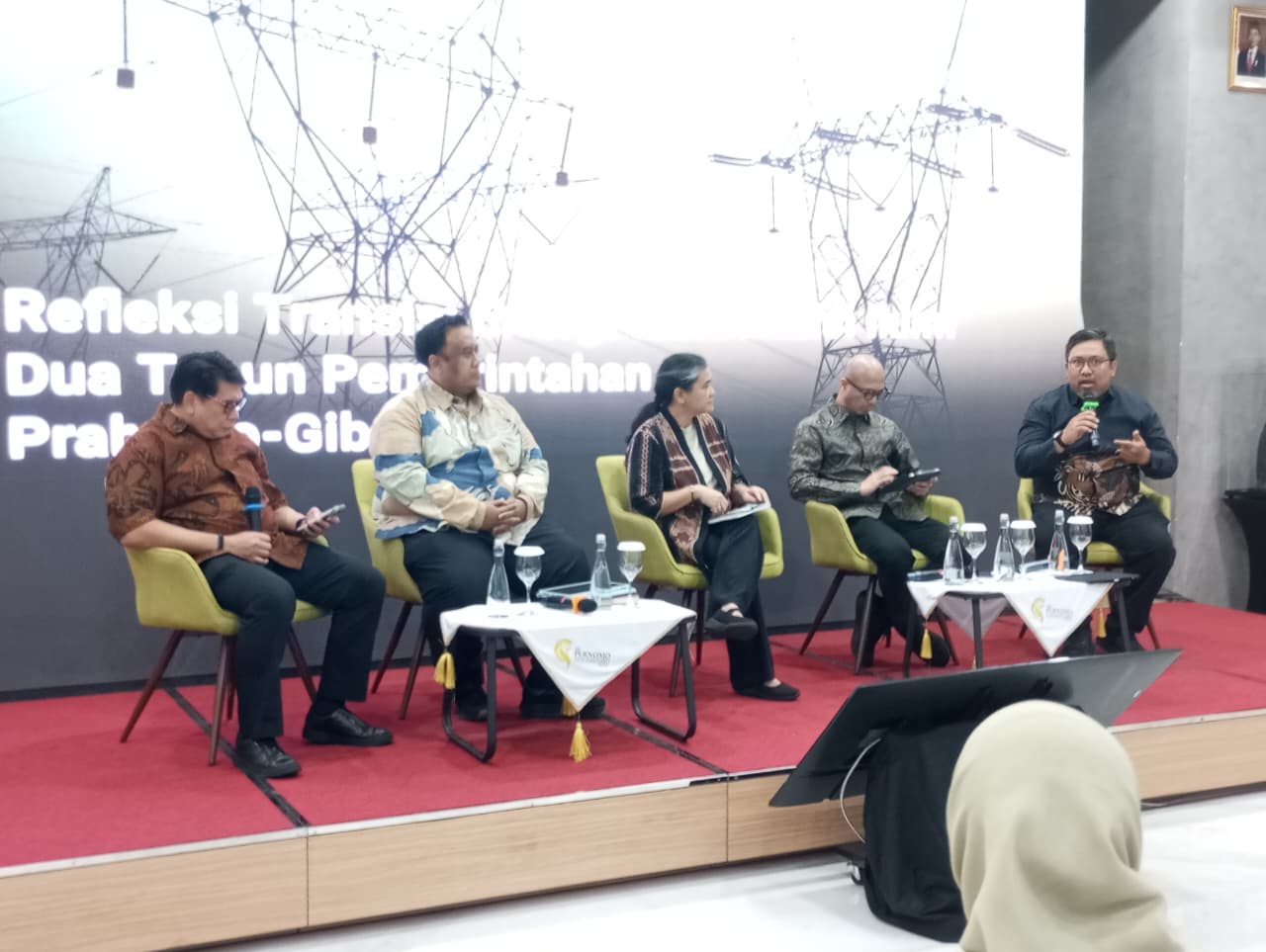
Fabby Tumiwa, Chief Executive Officer of the Institute for Essential Services Reform (IESR), said the Prabowo-Gibran administration had numerous energy-related agendas it sought to pursue. However, the pathways to achieving those targets were not yet entirely clear.
“As a result, we are having difficulty measuring the achievements made in the energy sector,” he said in Jakarta, on Friday, October 30, 2026.
Nevertheless, Fabby said this did not mean the government had made no progress over the past two years. In his view, the renewable energy agenda had advanced under the Prabowo-Gibran administration, as reflected in several key policies.
First, the government has accelerated solar energy development through plans to build solar power plants (PLTS) with a combined capacity of 100 gigawatts (GW).
The project was initially announced by the President in July 2025. However, implementation had yet to progress because it was not considered an urgent priority. Following the oil crisis triggered by conflict in the Middle East, the agenda was subsequently accelerated and linked to efforts to strengthen energy security.
“In my view, this is important. Previously, the program was discussed solely as a renewable energy agenda. Now, the development of 100 GW of solar power capacity is seen as an instrument to strengthen energy security. One of the initiatives being pushed by the President is replacing diesel-fired power plants (PLTD) with solar power plants and battery energy storage systems (BESS),” he said.
Fabby said the government aimed to achieve two objectives through the project. First, to reduce fuel consumption for power generation. Second, to improve public access to reliable electricity supplies across Indonesia.
He noted that electricity supply reliability remained suboptimal in areas that still depended on diesel-fired power plants. Under such conditions, residents could not necessarily count on receiving electricity around the clock.
“With this policy, we hope to achieve those two main objectives,” he said.
Second, the government is promoting the use of biofuels. After implementing the B40 biodiesel blend, the government accelerated plans to introduce B50. It is also promoting the E10 and E20 ethanol blending programs.
“Despite our criticism of the program, we have to acknowledge that the B50 policy could help Indonesia avoid pressure from diesel imports,” he said.
He noted that diesel prices were currently significantly higher than those of other petroleum fuels, based on developments in global energy prices.
According to him, the situation had even prompted the United States to allow Russia to sell diesel. The United States had also imported the product from Russia, adding another dimension to the conflict in Ukraine.
Third, the government is promoting an energy sovereignty doctrine based on three pillars. The first is reducing fuel imports. The second is processing natural resources domestically, including minerals.
The development of biofuels, he said, is also part of this effort. Indonesia has abundant feedstock for biofuel production, including palm oil.
Therefore, when the government says that implementing B50 can reduce diesel imports, the policy involves a trade-off. However, its economic implications still need to be taken into account. The same applies to ethanol development.
The third pillar is ensuring that energy remains affordable. According to Fabby, this explains why the government has maintained fuel subsidies and compensation schemes since the beginning of its administration.
On the other hand, Fabby criticized the government’s performance in renewable energy development. The target of achieving a 23% renewable energy share in 2025 was not met, with actual realization reaching only around 16%.
“Even the previous target of 17% in 2022 was also lowered. In my view, that figure may be revised once the 100 GW solar power capacity is included in the calculation,” he said.
GLOBAL GEOPOLITICAL CONDITIONS
Fabby said that as the administration entered its second year, Indonesia was facing global circumstances that had not previously been anticipated.
First, policies pursued by the United States under President Donald Trump had reshaped the global geopolitical landscape. These changes were reflected, among other things, in trade policies and relations between the United States and China. Changes in US foreign policy have implications for countries around the world.
One example is the trade agreement between Indonesia and the United States. Under the agreement, Indonesia had to commit to purchasing US$15 billion worth of oil and gas products.
“Imagine if the agreement had not been approved. The trade deal would not have gone through,” he said.
Second, the ongoing crisis in the Middle East has placed global energy supplies under pressure.
Fabby explained that the Strait of Hormuz is a shipping route through which around 20% of the world’s crude oil supply, equivalent to 20 million barrels per day, passes. However, on February 28, the route came under attack, after which Iran announced the closure of the Strait of Hormuz.
At the same time, global oil supplies declined, triggering an energy supply crisis. According to Fabby, the situation left many countries unprepared to face disruptions on such a large scale.
He said these two factors provided important context for understanding the government’s energy policies during the second year of the Prabowo-Gibran administration.
“We have to look at that context,” he said.
Against this backdrop, the government has sought to secure national energy supplies. Around 60% of Indonesia’s fuel requirements are still met through imports. Meanwhile, approximately 80% of the country’s liquefied petroleum gas (LPG) needs are also dependent on imports.
FISCAL SENSITIVITY
At the same event, Achmad Zacky Ambadar, Lead, Electric Mobility and Indonesia Energy at the International Institute for Sustainable Development (IISD), said Indonesia’s reliance on energy imports made its fiscal position highly sensitive to fluctuations in global oil prices. Every US$1 per barrel increase in oil prices could potentially add up to Rp10 trillion to government spending.
He said this sensitivity warranted attention because the oil price assumptions used in preparing the State Budget (APBN) could differ significantly from actual developments in global markets.
He cited the oil price assumption in the State Budget, which had been set at US$70 per barrel. However, geopolitical developments and conflicts in various regions had pushed actual oil prices to US$111.81 per barrel.
This represented a gap of approximately US$40 per barrel between the government’s assumption and the actual price. The situation added to fiscal pressure, as Indonesia also faced fluctuations in the rupiah exchange rate against the US dollar.
This is because crude oil purchases in international markets are denominated in US dollars. The combination of higher oil prices and a weaker rupiah could increase the government’s financial burden in meeting domestic energy needs.
Fiscal pressure is also linked to energy subsidy and compensation policies. He noted that the prices of several fuels paid by consumers did not yet fully reflect market prices, as part of the costs continued to be covered by the government through the State Budget.
The same applies to subsidized 3-kilogram LPG and electricity tariffs for certain customer groups. He cited the electricity tariff for households with a 450 volt-ampere (VA) connection, which remains at Rp415 per kilowatt-hour (kWh). Meanwhile, the cost of supplying electricity to this customer group was estimated at around Rp1,400 per kWh.
On the other hand, he said the current energy subsidy distribution scheme was not yet fully targeted. Therefore, the government needed to improve its recipient database to ensure more accurate subsidy distribution and better management of budgetary burdens.
He also said the government needed to reform electricity tariffs, strengthen coordination across ministries, and align energy transition targets with the policy instruments used to achieve them.
Regarding electric vehicles, he said previous government incentives had helped boost sales. However, those incentives had not been reinstated in 2026. An evaluation was therefore needed to identify the factors influencing electric vehicle sales trends.
Discover more