Logistics Occupancy Reaches 97% in Greater Jakarta

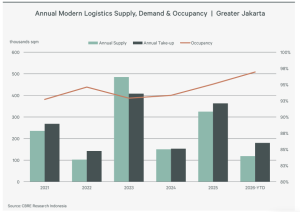
JAKARTA, JakartaWeekly.com—The logistics and industrial markets remained among Greater Jakarta’s strongest-performing property sectors in the third quarter of 2026, with logistics occupancy reaching approximately 97.0% and industrial land absorption totaling around 59 hectares.
Ivana Susilo, Head of Capital Markets & Industrial Logistics at CBRE, said strong logistics occupancy was supported by continued demand from e-commerce, manufacturing, third-party logistics providers and cold-chain operators. Limited new supply also helped sustain healthy market fundamentals and support rental growth across Greater Jakarta’s logistics corridors.
“Infrastructure quality is becoming one of the primary factors across industrial estates. For many occupiers, especially data center operators, reliable utilities are now just as important as location,” Ivana said in a press release on Wednesday, October 28, 2026.
In the industrial sector, land absorption reached approximately 59 hectares during the quarter, lifting overall occupancy across Greater Jakarta’s industrial estates to 91.6%. Occupiers continued to concentrate in established industrial corridors such as Cikarang and Karawang, where robust infrastructure and mature industrial ecosystems remain key competitive advantages.
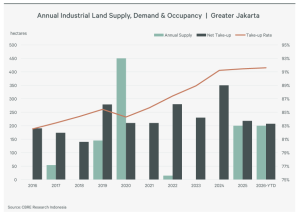
Infrastructure and utility quality are increasingly influencing occupier decisions, particularly among data center operators and technology-related industries. Reliable access to electricity, water and telecommunications has also contributed to continued land price growth in key industrial locations.
Jakarta CBD Office Occupancy Rises to 76.6%
Jakarta’s office market continued to show improvement in leasing activity, with occupancy in the central business district (CBD) rising to 76.6%, while non-CBD occupancy remained stable at 73.2%.
Judy Sinurat, Senior Director and Co-Head of Office Services at CBRE, reported that Jakarta’s CBD recorded approximately 22,900 sq m of net take-up during the third quarter. Occupancy reached its highest level since the pandemic recovery period.
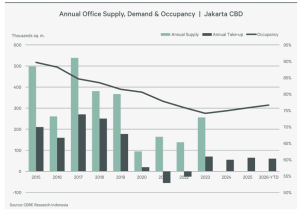
“Demand remained concentrated in Premium Grade and Grade A office buildings as occupiers continued to pursue flight-to-quality strategies. Buildings offering modern specifications, sustainability features, strong amenities and high-quality work environments continued to outperform the broader market,” Judy said.
Rental performance in Premium Grade and Grade A buildings also improved, reflecting stronger occupier preferences for higher-quality assets. Meanwhile, landlords increasingly focused on asset enhancement initiatives, including refurbishment programs, workplace improvements and upgraded facilities, to maintain competitiveness and strengthen tenant retention.
Jakarta’s non-CBD office market also recorded approximately 21,600 sq m of net take-up during the quarter, while occupancy remained stable at 73.2%, according to Albert Dwiyanto, Senior Director and Co-Head of Office Services at CBRE.
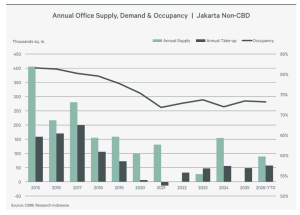
Occupier demand was primarily driven by government institutions and companies in the fast-moving consumer goods (FMCG), technology, chemicals and energy sectors. Accessibility and connectivity to major transportation networks remained key considerations, with well-connected locations continuing to attract interest.
“Occupiers are increasingly seeking the right balance between accessibility, cost efficiency, and building quality. Beyond rental considerations, workplace experience, operational efficiency, sustainability, and employee wellbeing are becoming increasingly important factors in location decisions. Buildings that continue to improve their facilities and overall tenant experience will be better positioned to attract and retain occupiers in an increasingly competitive market,” Albert said.
Jakarta Retail Mall Occupancy Rises to 86.8%
Jakarta’s retail market recorded another quarter of stronger performance, with overall mall occupancy rising to 86.8%, supported by positive net absorption and active expansion by retailers.
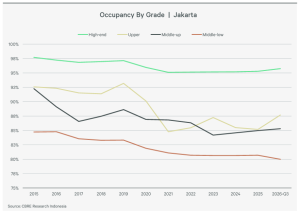
Anton Sitorus, Senior Director and Head of Research & Consulting at CBRE, said premium malls continued to outperform other segments, maintaining occupancy rates above 95% while recording stronger rental growth. Retailers increasingly favored high-performing destinations capable of delivering differentiated customer experiences.
“Consumers increasingly view malls as destinations for experiences rather than simply places to shop. This shift continues to benefit prime malls with stronger tenant mixes, lifestyle offerings and experiential components,” Anton said.
AI’s Impact on the Future of Real Estate
Anton also highlighted the growing influence of artificial intelligence (AI) on the future of real estate, noting that the technology was already changing how businesses operate, how employees work and how occupiers assess their space requirements.
Although concerns remain about potential job displacement, CBRE’s analysis suggests that AI is more likely to reshape existing occupations and improve workplace efficiency than materially reduce overall office demand in the near term.
Across Asia Pacific, only a relatively small proportion of employment is considered highly vulnerable to AI disruption, while most workers retain a strong capacity to adapt through reskilling and occupational mobility, according to CBRE’s analysis.
Angela Wibawa, Managing Director of CBRE Indonesia, said Indonesia’s economy remained supportive of property market activity despite global uncertainties.
“Indonesia continues to demonstrate economic resilience, supported by stable growth, moderate inflation, ongoing investment activity, and population growth supporting the domestic market. Occupiers remain active, but are becoming increasingly selective, focusing on quality, efficiency and long-term value creation,” Angela said.
Concluding the briefing, Angela emphasized that Jakarta’s property market continued to demonstrate resilience amid global uncertainties. She said Indonesia’s market fundamentals continued to improve across several sectors, particularly industrial, logistics and data centers.
“Looking ahead, technological transformation led by AI will create both challenges and opportunities, but the long-term outlook for Jakarta’s real estate market remains positive,” she concluded.
CBREGreater JakartaIndonesiaJakarta CBD officeJakarta non-CBD officelogistics and industrial marketsproperties
Discover more