Art Exhibition Brings Together Ancestral Knowledge, Technology and Nature
JAKARTA, JakartaWeekly.com— Petruk is widely known as one of the punakawan, the clown-servants in traditional Javanese wayang (puppet theatre). The character is closely associated with traditional stories passed down from one generation to the next.
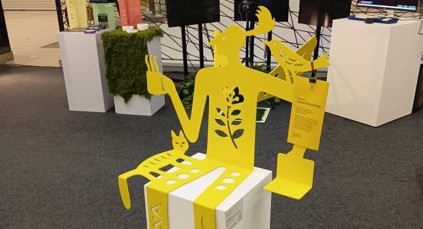
At an art exhibition at FX Sudirman in Jakarta, however, Petruk appears in an unusual form. The figure is bright yellow and sits on a white pedestal, with a bird perched on its shoulder and a cat resting on its lap.
The work, titled Petruk Future dan Time serta Ecology (2026), was created by designer and visual artist Hagung Sihag.
The Petruk differs from the character’s conventional depiction, although it retains the distinctive long nose. Leaf and floral motifs appear on the figure’s chest.
Its right hand holds a cup, while both legs dangle from its seated position. This familiar figure from traditional wayang is presented within a broader exploration of the future, time and ecology.
Elsewhere in the exhibition space, visitors encounter a different experience. Three vertical monitors mounted on tripod stands display images of flora, botanical information and natural landscapes.
One screen shows plants in a forest setting, featuring several interactive points. The middle screen presents botanical information in English through a digital interface, while the other displays a natural landscape.
Visitors can stand on a synthetic-grass-textured platform in front of the middle screen. By moving their hands, they can interact with the information displayed.
Through this work, knowledge about plants and the natural environment is presented using digital technology, not merely as something to look at but also as part of an interactive experience.
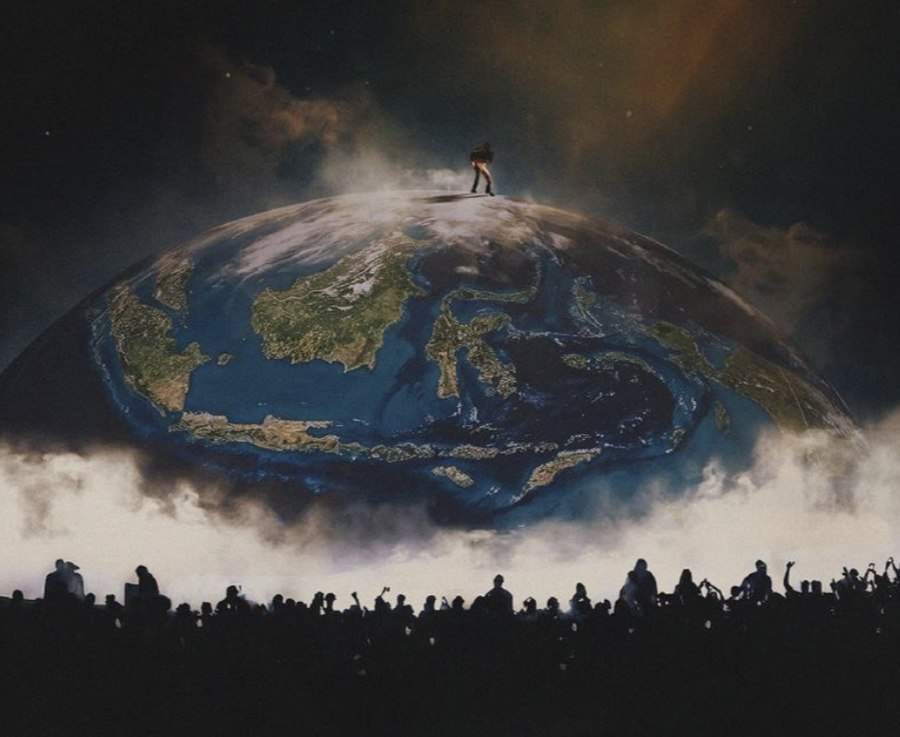
These two works, which take different artistic approaches, are part of Media X Space 2026. Held at the atrium and third floor of FX Sudirman from October 30 to November 12, 2026, the exhibition carries the theme “Future, Time, and Ecology: Ancestral Knowledge Echoing to the Future.”
The theme brings together three key areas explored in the exhibition: knowledge inherited from the past, developments in technology and contemporary artistic practices, and environmental challenges facing humanity today.
Hagung Sihag, a participating designer and lecturer at BINUS, highlighted the importance of rediscovering local knowledge amid technological developments and modernity.
“It is time for our creative professionals and artists to rediscover the roots of local knowledge,” he said.
Rediscovering local knowledge is particularly important because advanced technology and modernity can pose serious threats to ecological sustainability.
“This exhibition provides a convincing direction for us to revisit who we were and where we are heading as we contribute to our country,” Hagung said.
This idea is one of the connecting threads running through the exhibition, which features more than 30 professional artists, students, lecturers and university professors. They come from Indonesia, China, the United Kingdom, Hong Kong, Vietnam, Singapore and Malaysia.
The diversity of participants is also reflected in the range of artistic media on display. In addition to the two works described above, visitors can explore digital illustration, photography, graphic design, character design, moving images, installations, interactive and participatory media, three-dimensional objects, and digital technology prototypes.
These varied approaches demonstrate how art and visual technology serve as means for participants to communicate their ideas. At the same time, the exhibition’s theme draws attention back to knowledge from the past and its relationship with environmental issues.
Patricia Adele, the BINUS curator of Media X Space 2026, explained that the exhibition does not view developments in visual technology solely as part of artistic and design practices.
Knowledge and values from the past also form part of the process of developing perspectives for the future.
“Through art and design, combined with the latest developments in visual technology, this event also revisits the knowledge and values of the past, enabling us to reflect and adapt our perspectives as we embrace new values and look toward the future,” Patricia said.
The exhibition is a collaborative effort involving Arcolabs, BINUS School of Design, the Master of Design programme at BINUS Graduate Programme, and the Graphic Design and New Media International Programme at BINUS University.
Preparations for the exhibition also included a seven-month incubation process. Independent curator and art observer Bambang Asrini, who visited the exhibition, highlighted this process.
According to Bambang, Media X Space is more than just an exhibition of artworks. It is also part of an effort to build a new media art ecosystem by bringing professional artists and researchers together. The initial stage of the incubation process took place at Museum MACAN in mid-2026.
Alongside the connections between art, design and technology, environmental issues are central to the exhibition’s theme. Greenhouse gas emissions, forest fires and uncontrolled pollution are among the issues addressed in the exhibition.
Discover more