Can Indonesia Move Beyond Motorcycle Dependence?
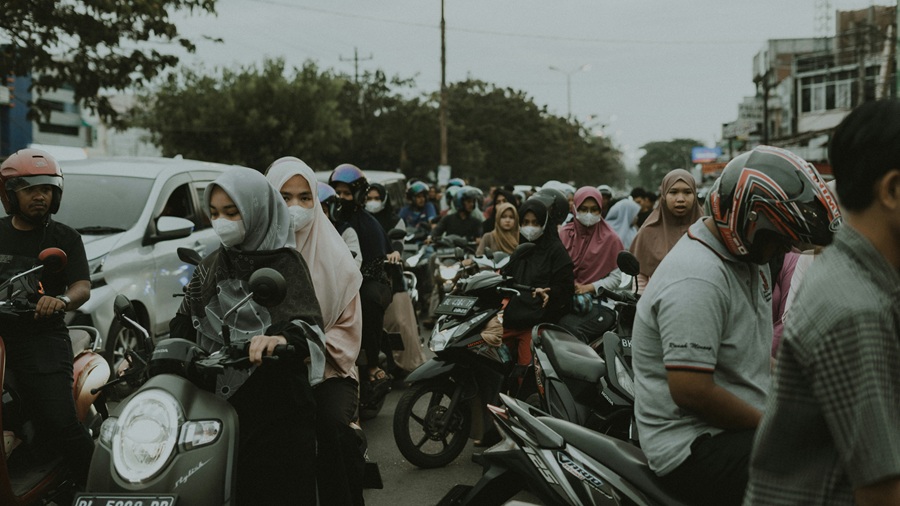
JAKARTA – Jakartaweekly.com. Motorcycles have become the backbone of transportation in Indonesia because they are affordable and widely accessible. However, their dominance has created serious challenges, including high accident risks and urban emissions, compounded by inadequate public transport services.
Motorcycles can navigate traffic congestion and narrow roads in densely populated cities. Their ownership and operating costs are substantially lower than those of cars, while their uses extend beyond personal transportation to informal transport services, online motorcycle taxis and logistics for micro, small and medium-sized enterprises (MSMEs).
Yet this accessibility comes with significant costs for road safety, the environment and urban mobility.
Motorcycles and Road Accidents
Data from the National Police Traffic Corps’ Integrated Road Safety Management System (IRMS) for 2024–2026 identifies motorcycles as the vehicle type most frequently involved in traffic accidents in Indonesia. Recorded accidents increased from 97,270 in the first half of 2025 to 114,130 in the second half, before rising further to 120,975 in the first half of 2026.
A study by the National Police Research and Development Centre found that two-wheeled vehicles accounted for approximately 75% of traffic accidents. This underscores the vulnerability of motorcycle riders, even as the total number of motor vehicles continues to grow and motorcycles consistently represent more than 75% of the vehicle population.
Young people face particular risks. Police research indicates that many traffic violations and accidents involve people of productive age, particularly those aged 17–35, including students and university attendees.
Motorcycles remain their primary mode of transportation because they are inexpensive, flexible and capable of reaching areas underserved by public transport. This also points to inadequate public transportation as a major factor behind the widespread use of motorcycles.
Indonesia’s Growing Motorcycle Population
Motorcycle ownership is concentrated in the Asia-Pacific region, both in terms of total vehicles and household ownership.
According to World Population Review data cited in the original article, India has approximately 271 million motorcycles, followed by Indonesia with 125 million. China has around 85 million, Vietnam 65 million, Thailand 22 million, Pakistan 18 million, Malaysia 15 million, Brazil and Nigeria 14 million each, and the Philippines 13 million.
Meanwhile, data from the National Police Traffic Corps’ Electronic Registration and Identification (ERI) system puts Indonesia’s registered motorcycle population at approximately 148 million. This figure includes registered vehicles that may no longer be operational or may have outstanding vehicle taxes.
The Indonesian Motorcycle Industry Association (AISI) records annual sales of approximately five to six million new motorcycles, adding to the accumulated number of vehicles on the road.
In terms of the percentage of households owning at least one motorcycle, Thailand leads at 87%, followed by Vietnam at 86%, Indonesia at 85% and Malaysia at 83%. Vietnam and Taiwan have the highest per-capita ownership ratios, at 0.77 and 0.62 motorcycles per person, respectively, according to the figures cited.
The Policy Dilemma: Affordable Mobility, Higher Costs
Motorcycle dependence presents a complicated policy challenge involving economics, safety, environmental sustainability and urban planning.
First, there is a tension between affordable transportation and the need for reliable public transit. Motorcycles offer inexpensive, flexible mobility, but their widespread use contributes to congestion, accidents, fuel subsidy burdens and lower public transport ridership. Many Indonesian cities still lack adequate public transportation, while some have virtually no services at all.
Second, road safety is closely linked to driver fatigue, the absence of clear working-hour limits and limited social security and employment protections, particularly for online motorcycle taxi drivers.
Third, enforcement remains important. Authorities must address technical violations such as brake failures, illegal vehicle modifications and non-compliance with Indonesian National Standards (SNI) for helmets.
Fourth, the transition to electric vehicles raises questions about whether incentives for private electric motorcycles would deliver greater benefits than investment in electrifying public transport fleets. Battery-swapping infrastructure and future battery waste management also remain significant challenges.
Finally, urban planning must accommodate motorcycles without allowing them to undermine pedestrian access. Motorcycle parking near train stations and bus terminals can support first- and last-mile journeys, but motorcycles occupying sidewalks and road shoulders during peak hours remain a concern.
How ASEAN Countries Regulate Motorcycles
ASEAN countries take different approaches to motorcycle passenger services, reflecting their public transport systems, infrastructure and mobility needs.
Singapore prohibits commercial passenger transportation by motorcycle, prioritising road safety and mass transit through its integrated MRT and bus networks, alongside taxis. Motorcycles are permitted for logistics and food delivery, subject to relevant requirements.
Malaysia has taken a more cautious approach to motorcycle ride-hailing. In early 2020, its Transport Ministry tested services such as Dego Ride and GrabBike in the Klang Valley under restrictions, including limits on operating areas. The government continues to prioritise feeder buses and urban rail services, including the MRT, LRT and KTM Komuter, while motorcycles remain widely used for deliveries.
Vietnam, by contrast, has integrated motorcycle ride-hailing into its transportation system. Drivers must meet licensing and equipment requirements, while platform companies are subject to applicable transportation, pricing transparency and tax regulations. Vietnam is also promoting electric motorcycles through partnerships with domestic manufacturers, including VinFast and its GSM/Xanh SM mobility services, alongside battery-swapping facilities.
These different approaches demonstrate that motorcycle regulation cannot be separated from the availability and quality of alternative transport options.
Should Motorcycle Taxis Be Recognised as Public Transport?
The proposed revision of Indonesia’s Law No. 22 of 2009 on Road Traffic and Transportation has renewed debate about the legal status of online motorcycle taxis, commonly known as ojol.
The debate involves legal certainty, passenger and driver protection, road safety and the economic realities of millions of people who depend on the sector.
An estimated seven million online motorcycle taxi drivers operate in Indonesia. The occupation has also changed over time. According to figures cited from the Institute of Transportation Studies (Instrans), only 5% of drivers were unemployed before entering the sector in 2016. A 2018 study by the Transportation Ministry’s research and development agency put the proportion at 19%.
A 2026 Kompas survey cited in the original article found that 48.5% viewed the work as a temporary means of earning a living, while 26.6% considered it a realistic primary occupation and 13.7% described it as flexible work suited to their circumstances.
The legal framework remains contentious. Presidential Regulation No. 27 of 2026 on the Protection of the Digital Platform-Based Transportation Ecosystem regulates the sector, but the original article argues that its legal position remains vulnerable to challenge because Law No. 22 of 2009 explicitly defines public passenger transport in terms of vehicles with three or more wheels.
Formal recognition could provide a stronger legal basis for regulating fares, limiting platform commissions and securing access to employment protections, including the national health and employment social security programmes. It could also clarify passenger and driver protection in the event of an accident.
Motorcycles also serve a practical feeder function, connecting densely populated neighbourhoods and narrow streets that conventional public transport cannot easily reach.
However, formal recognition carries risks.
Motorcycles lack the protective structure of larger passenger vehicles, leaving riders and passengers particularly vulnerable to serious injuries. The National Police Traffic Corps has attributed approximately 70%–75% of annual traffic accidents and fatalities to motorcycles, according to the figures cited in the original article.
There is also a risk that governments will rely on online motorcycle taxis as a quick solution to mobility problems rather than investing in safe, affordable and integrated public transport. Such dependence could weaken incentives for local governments to improve bus and rail services, even where regional budgets could support operational subsidies.
Additional administrative requirements could also impose financial burdens on drivers, including periodic vehicle inspections, special commercial registration plates, commercial driving licences and business registration requirements.
Without effective planning, a larger commercial motorcycle fleet could worsen congestion, increase sidewalk and roadside occupation, and add to urban emissions.
Integrating Motorcycle Taxis with Public Transport
Any legal framework should ensure that motorcycles complement rather than replace mass transit.
One proposal is to restrict passenger pick-ups and drop-offs along major public transport corridors within a designated buffer zone, such as 500 metres, while directing motorcycle taxi services towards nearby stations and bus stops.
Ride-hailing platforms could also be integrated with public transport ticketing systems, allowing passengers to purchase combined motorcycle taxi and transit journeys at more affordable package rates.
Local governments could be given authority to limit the number of commercial motorcycles operating in their jurisdictions to prevent oversupply. A portion of savings from more efficient subsidies could support incentives for journeys that begin or end at bus stops and railway stations.
Three-wheeled alternatives, including modernised bajaj vehicles and electric rickshaws, could also provide passenger transport options with greater physical stability than two-wheeled motorcycles.
These measures would require coordination among national and local governments, transport operators and digital platforms.
Why Reducing Dependence on Online Motorcycle Taxis Matters
A longer-term solution, in the author’s view, is to gradually reduce the number of online motorcycle taxi drivers and redirect the sector towards courier and delivery services.
This would be difficult and require time, but it should not be dismissed simply because the transition is challenging. The government could establish a measurable national roadmap, including five-year targets for reducing dependence on passenger motorcycle taxi services and expanding alternative employment opportunities.
The underlying issue is not only transportation. It is also the availability of decent work.
If online motorcycle taxi driving becomes the primary livelihood for millions of people, improving earnings through regulation alone may not resolve the sector’s structural problems. The government also has a responsibility to create more secure employment opportunities beyond platform-based motorcycle services.
For consumers, meanwhile, motorcycle taxis cannot fully address the safety requirements expected of a modern public transport system. The limitations extend beyond accident risks to environmental sustainability and public health.
The author also argues that reducing platform commissions, including through the 8% deduction provision under Presidential Regulation No. 27 of 2026, will not by itself resolve these broader issues. Excessive financial pressure on platform operators could also threaten business viability and potentially increase unemployment.
The growth of online motorcycle taxis reflects two underlying problems: inadequate public transportation and limited employment opportunities.
Indonesia aims to become a developed country by 2045. A key measure of that ambition should be the availability of integrated, reliable public transportation, rather than the extent to which millions of residents depend on motorcycle taxis for their daily mobility and livelihoods.
Making Motorcycles Part of the Solution
Resolving Indonesia’s motorcycle dilemma requires more than changing regulations or switching from fossil fuels to electricity.
The government must take a central role in developing policies that make motorcycles complementary to mass transit, rather than substitutes for it. Legal recognition and regulation of motorcycle services should proceed alongside a clear commitment to improving public transportation across Indonesian cities and regions.
The objective should be to protect passengers, provide drivers with legal certainty and employment protections, and build a more sustainable transportation system.
Motorcycles will remain part of Indonesia’s mobility landscape. The challenge is ensuring that their role supports, rather than undermines, the development of a safer and more integrated public transport network.
Written by: Djoko Setijowarno is an academic in the Civil Engineering Study Programme at Soegijapranata Catholic University and an adviser to the Indonesian Transportation Society (MTI).
Editor: Rafael
Discover more