Bank Mandiri Account Freeze May Hurt Trust, but No Risk to Indonesia’s Banking System

JAKARTA, Jakartaweekly.com — Bank Mandiri’s decision to suspend transactions on a customer’s account at the request of law enforcement authorities could potentially undermine public trust in the state-owned lender, a banking expert has warned.
Professor Dwi Hayu Agustini, a lecturer at the Faculty of Economics and Business at Soegijapranata Catholic University, said the political element surrounding the case could affect public trust in Bank Mandiri.
The move could not only undermine public trust but also damage the bank’s strong reputation, which it has built over the years. However, Hayu said the case would not have a significant impact on the national banking sector.
“I describe it as ‘potentially’ because the extent of the impact on Bank Mandiri’s reputation and public trust will depend largely on how Bank Mandiri handles and resolves the case,” Hayu told Jakarta Weekly on Tuesday, August 25, 2026.
She said the suspension of customer accounts was generally common practice in the banking industry. Banks have the authority to take such action to prevent the misuse of funds or money laundering. However, the process must be carried out in accordance with applicable legal procedures.
Hayu said the Bank Mandiri case was unusual because of its political dimension. In terms of the amount involved, Rp80.9 million, she said the case was not significant, particularly because the account belonged to an individual customer.
The case was different, she added, because the account was linked to the Aliansi Masyarakat Pati Bersatu (AMPB), which authorities reportedly considered potentially disruptive to public order and security in connection with a planned demonstration.
Although Bank Mandiri has said the transaction suspension was carried out at the request of law enforcement authorities, Hayu said the legal basis and context underlying the action remained unclear.
“This indicates a weakness on the part of Bank Mandiri’s management in making the decision to suspend the customer’s account. The ease with which the bank’s management can be influenced by external parties demonstrates the bank’s weak position vis-à-vis certain parties, particularly those with political interests,” she explained.
Hayu further said the impact of the case would likely be limited to public and investor trust in Bank Mandiri. State-owned banks and the national banking sector as a whole would not be significantly affected.
She compared the case with a BNI case involving the embezzlement of Rp28 billion belonging to church customers. In her view, the Bank Mandiri account-suspension case was relatively small in terms of the amount involved. The BNI case also did not trigger a bank run or large-scale withdrawals by BNI customers.
“People are now increasingly informed and able to assess whether a case is systemic and capable of causing disruptions or problems that affect many parties. This is what will influence customers’ decisions in responding to a particular case,” she said.
Hayu also emphasized the importance of transparency in banking, particularly in the management of customer funds, because banking is fundamentally a trust-based business. Transparency is therefore one of the key factors in building and maintaining that trust.
The same principle applies to transparency surrounding the suspension of customer accounts, the mechanism for which is already regulated. As long as an account suspension is carried out in accordance with legal procedures, transparency can be maintained and public trust preserved.
“From an economic perspective, the impact will depend heavily on the circumstances surrounding the account suspension. If an account suspected of containing proceeds from corruption or money laundering involves a very large amount of money, the economic impact could be highly significant. Conversely, if the account belongs to an individual customer and contains a relatively small amount, the economic impact would be very limited,” she explained.
For this reason, Hayu does not believe the case is likely to trigger a bank run, despite the #boikotMandiri (“boycott Mandiri”) hashtag going viral on social media. This is particularly true if Bank Mandiri is able to resolve the account-suspension case properly.
She said there may be an intention to boycott the bank, but that intention would not necessarily translate into behavior in the form of customers actually withdrawing their funds from Bank Mandiri.
OJK and Law Enforcement Authorities Provide Clarification
The Jakarta Metropolitan Police (Polda Metro Jaya) has officially clarified the status of Supriyono’s account.
Polda Metro Jaya Public Relations Head Commissioner Budi Hermanto explained that the letter submitted by investigators from the Polda Metro Jaya Directorate of Special Criminal Investigation concerned the suspension of transactions, rather than a freeze on the account.
According to Budi, the request to suspend transactions was made pursuant to Article 26 of Law No. 8 of 2010 on the Prevention and Eradication of Money Laundering (TPPU).
Under the provision, transactions may be suspended for a maximum of five working days from the date the request was submitted, namely Friday, August 21, 2026.
Investigators also invoked Article 237 of Law No. 4 of 2023 to examine the legality of the public fundraising activities. According to Budi, fundraising activities must be conducted under a business entity license and cannot be carried out by an individual.
Budi confirmed that the Rp80.9 million in donations had not been confiscated and remained intact. If the investigation finds no indication of a criminal offense, access to Supriyono’s account will be restored after the five-working-day suspension period expires.
Meanwhile, OJK Chief Executive for Banking Supervision Dian Ediana Rae said the suspension of transactions on a bank account is part of a security procedure supervised by the Financial Services Authority (OJK). The mechanism does not mean that customers’ funds have been lost or permanently frozen.
The OJK also said it understood public concerns over the issue. According to the regulator, matters involving bank accounts can affect public perceptions and trust in the banking industry and the financial system.
However, Dian stressed that the transaction-suspension mechanism complies with existing regulations and serves to protect customers’ interests while safeguarding the stability of the financial system.
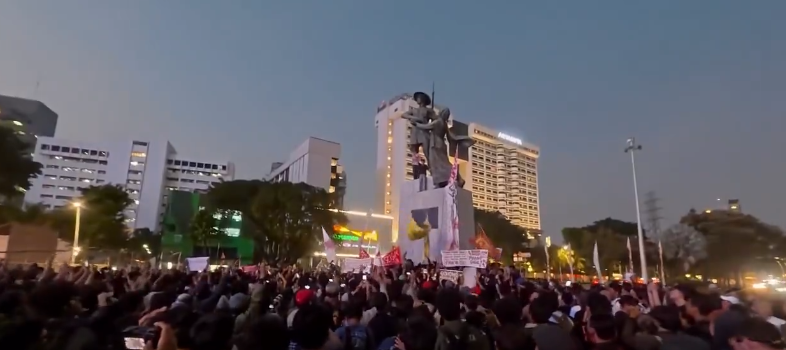
Supriyono’s bank account was reportedly subjected to a transaction suspension while he was accompanying residents of Pati to convey their aspirations in Jakarta on Friday, August 21, 2026. The account contained both personal funds and public donations intended to support the demonstration. The issue subsequently went viral on social media.
Aliansi Masyarakat Pati Bersatubank mandiriBank Mandiri AccountBank Mandiri Account FreezeOm BotokPati
Discover more