Indonesia Records US$3.83 Billion Trade Deficit with Singapore in January–May 2026
JAKARTA, Jakartaweekly.com — Indonesia’s reliance on gasoline imports from Singapore continues to weigh on the two countries’ bilateral trade balance. Data from Statistics Indonesia (BPS) show that gasoline imports worth US$3.52 billion accounted for about 92% of Indonesia’s US$3.83 billion trade deficit with Singapore during the January–May 2026 period.
According to Statistics Indonesia, Indonesia’s exports to Singapore reached US$5.07 billion, while imports from Singapore totaled US$8.89 billion during the same period. A closer look at the trade data shows that Indonesia’s exports to Singapore remain heavily concentrated in raw materials, particularly natural gas, fuel oil, diesel fuel, and petroleum residues.
Based on Jakarta Weekly’s analysis of BPS data, the 10 largest export commodities were valued at US$2.50 billion, accounting for 49.3% of Indonesia’s total exports to Singapore.
Top 10 Indonesian Exports to Singapore (January–May 2026)
| HS Code | Commodity | Value (US$) |
| 27112190 | Natural gas in gaseous state (other than motor fuel) | 820,347,709.29 |
| 27139000 | Other petroleum residues | 438,760,321.90 |
| 71131990 | Other precious metal jewelry (excluding silver) | 387,878,690.86 |
| 27101979 | Fuel oil | 251,428,803.30 |
| 27101971 | Automotive diesel fuel | 135,956,068.03 |
| 85423900 | Electronic integrated circuits (excluding processors, controllers, memory, or amplifiers) | 124,028,773.06 |
| 75021000 | Unwrought nickel | 103,832,500.53 |
| 84733010 | Assembled printed circuit board parts and accessories for machines under HS 8471 | 83,379,228.94 |
| 85322200 | Aluminum electrolytic capacitors | 80,164,149.78 |
| 28182000 | Aluminum oxide (other than artificial corundum) | 78,967,638.83 |
| Total | 2,504,743,884.52 |
Meanwhile, Indonesia’s imports from Singapore were dominated by petroleum products, including gasoline, bitumen, lubricant base oil, diesel fuel, and jet fuel. The value of these 10 largest imported commodities reached US$6.37 billion, representing 71.7% of Indonesia’s total imports from Singapore.
Among these imports, unleaded gasoline with an octane rating (RON) of 90 or above but below RON 97, unmixed, accounted for the largest share. Imports of this product reached US$3.52 billion, equivalent to 39.53% of Indonesia’s total imports from Singapore.
The figures highlight Indonesia’s continued dependence on imported gasoline from Singapore.
Top 10 Indonesian Imports from Singapore (January–May 2026)
| HS Code | Commodity | Value (US$) |
| 27101224 | Unleaded gasoline with RON 90 or above but below RON 97, unmixed | 3,518,159,706.95 |
| 27101971 | Automotive diesel fuel | 913,530,776.83 |
| 84714990 | Other personal computers in system form (excluding laptops/notebooks) | 839,382,862.39 |
| 71081210 | Non-monetary gold in unwrought form (lumps, ingots, or cast bars) | 341,979,860.72 |
| 27101941 | Lubricant base oil | 186,389,746.16 |
| 27101280 | Reformate, naphtha, and other preparations for blending into motor fuels | 174,465,588.88 |
| 27101981 | Aviation turbine fuel (jet fuel) with a flash point of 23°C or higher | 142,486,978.62 |
| 90148090 | Navigation instruments and appliances not elsewhere classified under HS 9014 | 94,353,178.59 |
| 33029000 | Odoriferous substances and mixtures used as industrial raw materials (excluding food and beverage industries) | 79,905,346.78 |
| 27132000 | Petroleum bitumen | 76,439,987.08 |
| Total | 6,367,094,033.00 |
Economist Says Refinery Investment Is the Long-Term Solution
Bhima Yudhistira, Economist and Executive Director of the Center of Economic and Law Studies (CELIOS), said the trade imbalance reflects Indonesia’s continued reliance on fuel products refined in Singapore.
“As a result, Indonesia exports crude oil while relying on Singaporean refineries to process it. This creates a disadvantage in the trade balance because Indonesia has to import certain grades of refined fuel, which are significantly more expensive,” Bhima told Jakarta Weekly on Thursday (July 16).
He added that another structural factor behind the deficit is Singapore’s longstanding role as a regional oil and gas import hub. Unless part of this function is shifted to Indonesia, the country will continue purchasing refined petroleum products from Singaporean refineries, regardless of where the crude oil originates.
A similar situation exists in the natural gas sector. Indonesia continues to import gas-related products, including those used in fertilizer production, from Singapore. Looking ahead, domestic gas demand is expected to rise significantly, particularly with plans to develop 10.3 gigawatts (GW) of gas-fired power plants. Indonesia, currently a net exporter of liquefied natural gas (LNG), could become a net LNG importer by 2030 if gas-based power generation expands as planned.
“Singapore remains the regional hub for importing gas-derived products. Therefore, investment in domestic refinery technology is essential,” Bhima said.
He also noted that the weakening rupiah and higher global oil prices have contributed to the widening trade deficit with Singapore.
To reduce dependence on imported fuel, Bhima suggested promoting public transportation, expanding electric vehicle adoption, and encouraging more efficient energy consumption. Over the long term, these measures could significantly reduce Indonesia’s imports of refined petroleum products from Singapore.
“We need comprehensive reforms in energy subsidies as well as the types of fuel produced domestically,” he added.
With Indonesia’s fuel consumption increasing every year, the issue extends beyond the trade balance. Rising fuel imports also increase the government’s energy subsidy burden, putting additional pressure on the state budget. Higher fuel imports also require larger foreign exchange outflows, which could further weaken the rupiah.
Indonesia and Singapore Sign 26 Strategic Agreements
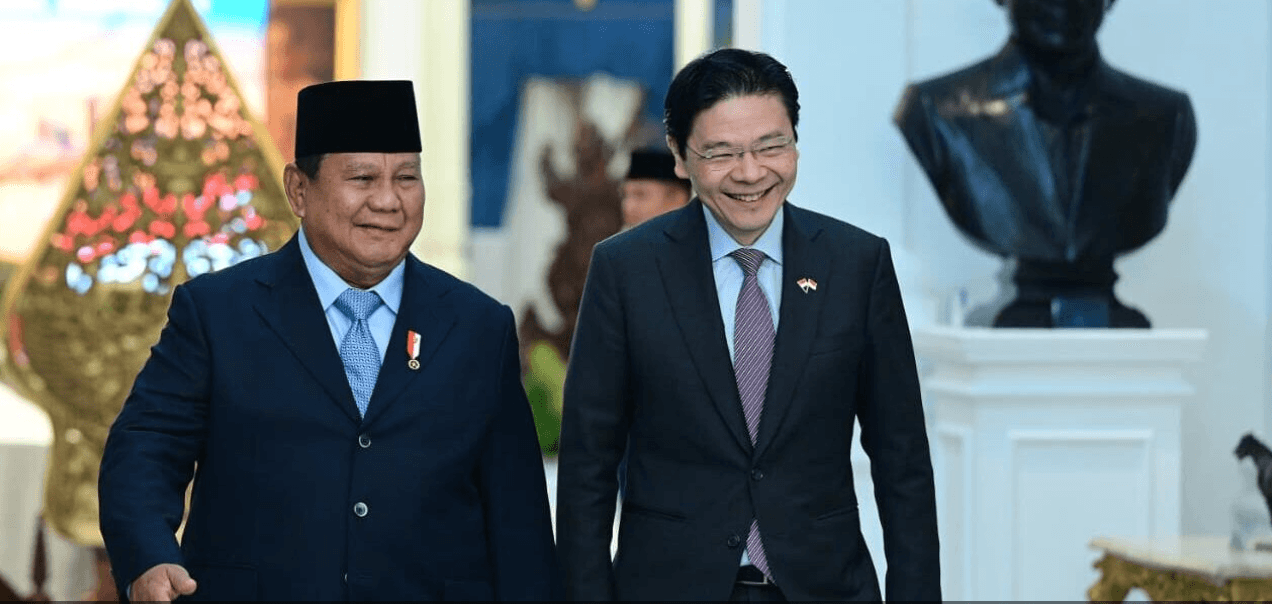
Indonesian President Prabowo Subianto and Singaporean Prime Minister Lawrence Wong recently agreed on 26 strategic cooperation initiatives during the Leaders’ Retreat held in Jakarta on July 7.
The agreements cover strengthening economic resilience and supply chains, accelerating the green energy transition through cross-border electricity trade and carbon credits, and expanding cooperation in digital infrastructure and artificial intelligence (AI).
The partnership also extends to defense, air connectivity, industrial estate development, and social and legal cooperation, including healthcare, education, women’s empowerment, and parliamentary collaboration.
Prime Minister Wong also highlighted Indonesia’s significant potential in renewable energy development. He expressed Singapore’s readiness to become a strategic partner in harnessing that potential, including through the development of solar power projects in Morowali, Central Sulawesi.
“We are highly optimistic about Indonesia’s future prospects. Singapore is committed to further strengthening this strategic partnership, both in supporting the green energy transition and enhancing our shared defense capabilities to ensure that our region remains stable, secure, and prosperous,” Wong said.
Bhima YudhistiraBilateral TradeCELIOSEnergyEnergy SecurityExportsFuel ImportsGasoline ImportsImportsIndonesialawrence wongOil RefineryPetroleum ProductsPrabowo SubiantoRefined FuelSingaporeStatistics Indonesia (BPS)trade balanceTrade Deficit
Discover more