Indonesia Ranks 2 in Fortune Southeast Asia 500, but Manufacturing Lag Behind Vietnam
JAKARTA, Jakartaweekly.com—Indonesia ranked second in the latest Fortune Southeast Asia 500, with 104 companies making the list of region’s highway-revenue corporations.
However, expert argue that Indonesia’s strong corporate presence has yet to translate into greater competitiveness in the manufacturing sector, where the country continues to lag behind Vietnam.
According to Economist of Institute for Economic and Social Research (LPEM) FEB UI Teuku Riefky, Vietnam has outperformed Indonesia in manufacturing largely due to a more favorable business and investment environment.
“Vietnam’s business and investment climate is more predictable, more efficient, and easier for investors compared with Indonesia,” Riefky told Jakarta Weekly, Friday (19/6).
Riefky said Indonesia needs to accelerate reforms aimed to improving the investment climate, particularly in manufacturing. Key challenges include rent-seeking practices, regulatory complexity, and legal uncertainty.
The contrast between the two countries is reflected in their economic structures. According to World Bank data, manufacturing accounted for approximately 24% of Vietnam’s GDP in 2024, compared with only 19% in Indonesia. As a result, manufacturing plays a significantly larger role in Vietnam’s economy.
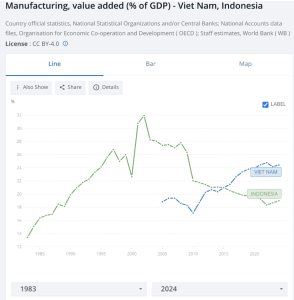
Indonesia’s manufacturing share has also declined over the long term. In the early 2000s, the sector contributed around 27% of GDP, highlighting a gradual trend of relative deindustrialization.
Data from Vietnam Briefing show that Vietnam’s manufacturing sector expanded by 9,97% in 2025, contributing 31.49% of the country’s total value-added economic growth during the year.
In Indonesia, meanwhile, manufacturing accounted for 19.07% of GDP in 2025, according to Statistics Indonesia (BPS). The sector grew by 5.3% year-on-year, while contributing 1.07 percentage points to Indonesia’s overall economic growth of 5.11%.
These figures suggest that Indonesia’s position as the second-largest contributor to the Fortune Southeast Asia 500 reflects the scale of its major corporations particularly state-owned enterprises (BUMN) rather than the strength of its manufacturing base. The ranking also highlights Indonesia’s continued dependence on energy-related business, while Vietnam continues to strengthen its position as a regional manufacturing hub.
Riefky emphasized that manufacturing deserves greater policy attention because it creates jobs on a large scale, supports exports, and reduces dependence on raw commodity exports. In other words, manufacturing is one of the most important indicators of the quality economics growth.
Indonesia’s Top 10 Companies in Fortune Southeast Asia 500
Thailand ranked first in the Fortune Southeast Asia 500 with 105 companies, followed by Indonesia (104), Malaysia (93), Singapore (82), Vietnam (72), and the Philippines (42).
Indonesia’s top-ranked companies were dominated by state-owned enterprises, particularly in strategic sectors such as energy, utilities, and banking. The top 10 included:
The top 10 Indonesian companies on the list are as follows:
| Company | 2025 Revenue | 2025 Profit | 2025 Assets |
| Pertamina | US$70.89 billion (-5.9%) | US$3.35 billion (+7.2%) | US$91.63 billion |
| PLN | US$35.41 billion (+2.8%) | US$426.3 million (-61.9%) | US$110.22 billion |
| Bank Rakyat Indonesia (BRI) | US$20.12 billion (+13.8%) | US$3.44 billion (-9.4%) | US$128.1 billion |
| Bank Mandiri | US$12.95 billion (+18.7%) | US$3.42 billion (-2.9%) | US$169.76 billion |
| Telkom Indonesia | US$8.92 billion (-5.8%) | US$1.08 billion (-27.5%) | US$17.26 billion |
| Bank Central Asia (BCA) | US$7.7 billion (+1.3%) | US$3.49 billion (+1.0%) | US$95.19 billion |
| Sumber Alfaria Trijaya | US$7.7 billion (+3.2%) | US$207.3 million (+4.3%) | US$2.55 billion |
| Barito Pacific | US$7.63 billion (+219.7%) | US$489.8 million (+766.9%) | US$17.35 billion |
| Indofood Sukses Makmur | US$7.5 billion (+2.6%) | US$649.3 million (+19.0%) | US$13.08 billion |
| Bank Negara Indonesia (BNI) | US$5.89 billion (-0.7%) | US$1.22 billion (-10.1%) | US$81.71 billion |
The list underscores the dominant role of state-owned enterprises in Indonesia’s corporate landscape. Companies such as Pertamina and PLN operate in sectors with limited competition and remain central to the country’s economy.
Among private-sector companies, Barito Pacific delivered one of the strongest performances, with revenue surging 219.7% and profit jumping 766.9% year-on-year.
Another notable performer was Aneka Tambang (ANTM), which ranked 74th on the list. The company posted a 17.7% increase in revenue to US$5.14 billion, while net profit rose 90.2% to US$438 million.
Fortune also noted that companies operating in commodities and energy continued to dominate the regional rankings, generating a combined US$1.88 trillion in revenue and US$150 billion in profits.
Vietnam stood out as the fastest-growing market in the ranking. Revenue generated by Vietnamese companies rose 10.5% to US$177.9 billion, accounting for roughly a quarter of the total revenue increase across the entire Fortune Southeast Asia 500 list.
Among Vietnamese firms, Petrovietnam ranked among the top 20 with revenue of US$24.31 billion and profit of US$1.78 billion.
Meanwhile, Vingroup recorded the highest revenue growth among major Vietnamese companies, with revenue increasing 69.1% to US$12.76 billion. Profit growth was led by VietinBank, whose earnings rose 31.5% to US$1.33 billion.
Discover more