When Education’s Lessons Are Not Enough to Face Life’s Waves
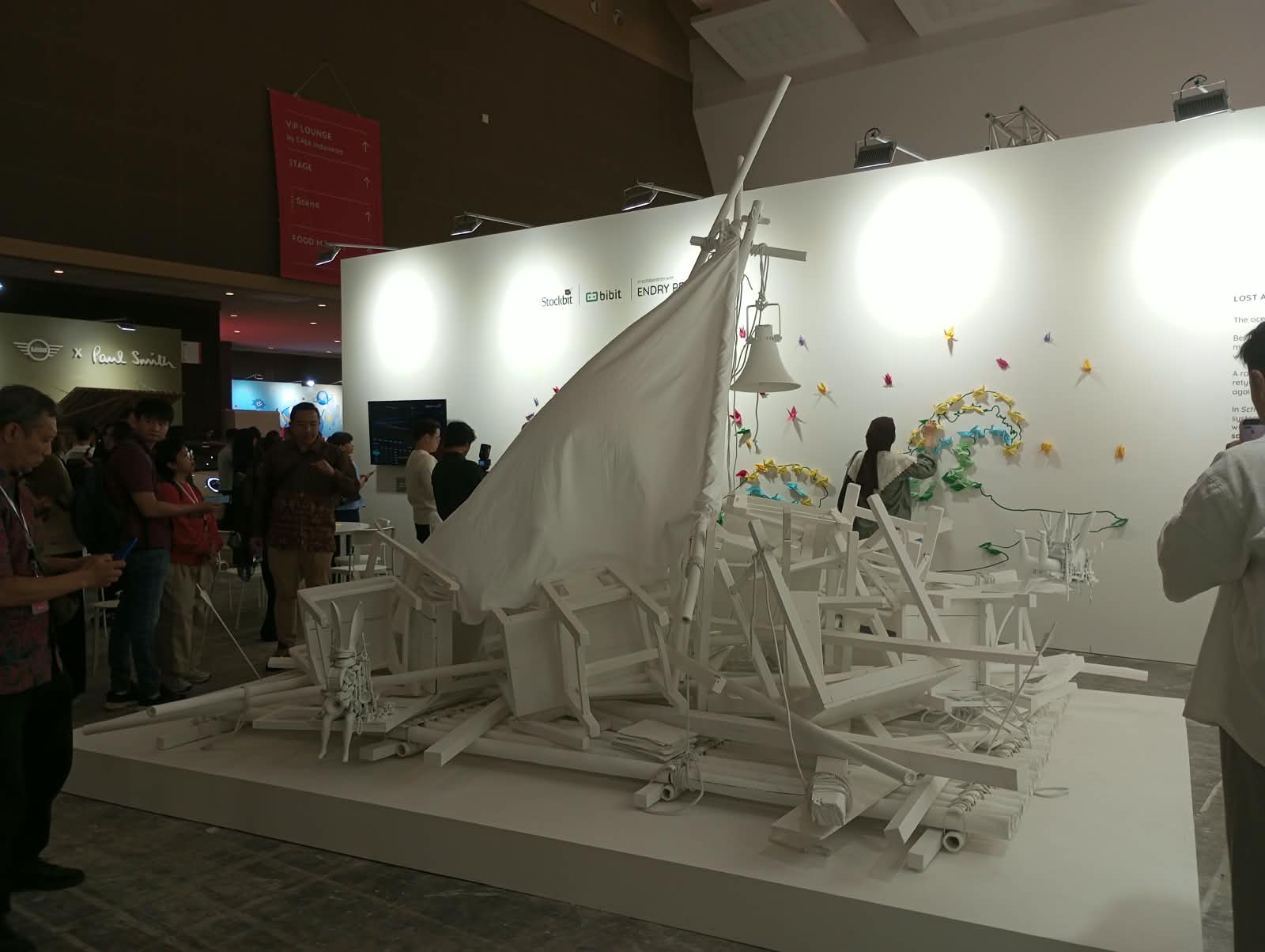
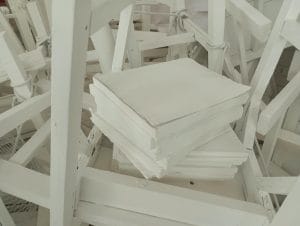
JAKARTA, Jakartaweekly.com—White covers almost every surface of the installation, from school desks and pieces of wood to computers, keyboards, books, megaphones and human figures that seem to have lost their original colors. Everything is brought together in a disorderly structure resembling a raft, creating an unusual image of something built to stay afloat amid an uncertain journey.
A large white fabric sail rises from the center of the structure, but there is no clear sense of where the raft is heading or whether it is even moving toward a particular harbor. Instead, it appears to be waiting for whatever the next wave may bring.
Titled School of Medusa II, the work by Yogyakarta-based artist and educator Endry Pragusta is presented by BIBIT and Stockbit at Art Jakarta 2026. From a distance, the installation resembles a vessel assembled from objects closely associated with learning, including school desks, wooden boards, books, computers and various communication devices, yet their disorderly arrangement suggests that the journey ahead may be far less predictable than the preparation that came before it.

Among the objects are a long-eared figure with its mouth wide open, several megaphones and a human figure sitting on top of computer equipment while wrapped entirely in white fabric. More than a collection of school desks, boards, books, computers and keyboards placed on a raft, the installation speaks about Indonesia’s education system and the challenges that remain when people take what they have learned into an unpredictable world.
For Endry, the sea is not merely a setting for the work, but a representation of a world that never stops changing. In the narrative accompanying Lost at Sea, he describes tides and currents as forces that constantly move and test whatever has been built upon the water, suggesting that survival depends not on remaining rigid but on being able to adapt, reconnect what has come apart, adjust the sail and find balance as the waves change.
When the current shifts, the journey has to change with it.
That idea provides an important entry point for understanding School of Medusa II, in which Endry portrays the education system as something adrift, leaving people to navigate an uncertain future with provisions that may not always be sufficient for everything they will eventually encounter.
The educational objects in the installation are therefore not arranged as a neat classroom or a perfectly organized system, but become part of a raft that must somehow remain afloat.
There is an irony in that image: education is expected to provide people with the knowledge and skills needed to face life, yet life rarely arrives in the form of problems for which the answers have already been taught in the classroom.
William Ndut, Head of PR and Corporate Communication at BIBIT and Stockbit, said the installation represents Endry’s reflection on Indonesia’s education system.
According to William, the system has provided people with knowledge and preparation to develop certain skills for life, but there is still unfinished work when those skills encounter situations that fall outside what they have expected or been prepared to face.
That does not make the knowledge and skills provided by education meaningless. The more difficult question is what happens after people leave the classroom and have to confront a reality that keeps changing around them.
At that point, the work becomes more than a reflection on education and begins to connect with another journey familiar to many people: their financial lives.
As Endry’s narrative suggests, a person may learn how to earn money without necessarily receiving the same preparation for protecting and growing what has already been built, leaving another gap to be navigated once financial decisions become part of everyday life.
The financial world has its own waves, with periods of favorable economic conditions followed by moments when circumstances move in an entirely different direction.
Asset values can change, markets can become volatile, and decisions that appear reasonable today may produce very different outcomes in the future, making the ability to respond to uncertainty just as important as the knowledge used to make the initial decision.
For that reason, the message of the work is not about predicting every wave before it arrives. Instead, it emphasizes the importance of learning to read changing conditions, choosing a direction and remaining composed when the circumstances no longer resemble those that existed when the journey began.
William said the artist uses the metaphor of a sail to convey this idea. In investing, people cannot force the wind to blow in the direction they want; what they can do is adjust the sail, respond to changing conditions and find a way to remain on course even when the journey becomes difficult.
“Even when there are waves, the skill is learning how to endure rather than forcing the wind to blow in a particular direction,” William said.
The metaphor makes the raft in School of Medusa II feel increasingly close to everyday life because a raft is not a large vessel promising a smooth and predictable journey. It is a means of staying afloat, which means the pieces of wood must remain tied together, the sail must be adjusted when the wind changes and balance must continually be found as the water moves beneath it.
The same can be said of people. Education provides knowledge, experience provides lessons and technology provides access to information, but none of these can guarantee that life will unfold according to plan or that the conditions we encounter will resemble those we were prepared for.
Ultimately, each person still has to steer their own raft. It is in this context that BIBIT and Stockbit place the work within the broader narrative of investing.
Stockbit is positioned as helping investors understand changing market conditions through information and insights, while Bibit focuses on supporting an investment journey toward long-term financial goals.
Yet Endry’s work allows the message to be viewed from a much broader perspective because uncertainty is not a challenge reserved for investors. A student leaving school encounters it, a young professional entering the workforce encounters it, and parents thinking about the future of their families encounter it in their own ways.
Everyone has a different sea to navigate, and everyone sets out with a different set of provisions. Some have more knowledge, others have more experience, while some have greater financial or social resources, but no one can know exactly when the next wave will arrive or how high it will be.
That uncertainty is also part of what allows art to speak differently to different people. William said BIBIT and Stockbit’s experience participating in Art Jakarta has taught them that a work of art can be understood in different ways depending on the person standing in front of it.
For William, art is not simply a matter of transferring an artist’s thoughts directly into the mind of an audience. Each viewer brings their own experiences, backgrounds and perspectives to a work, selecting and connecting with the messages that feel relevant to their own lives.
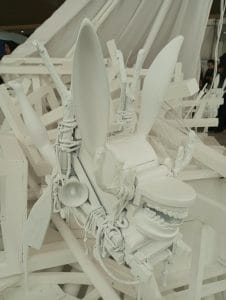
One person may see the school desks as a reflection of education, while another may see them as a reminder of childhood or a past that has already been left behind. The figure wrapped in white fabric may raise questions about isolation or uncertainty for one viewer, while the megaphone may suggest communication, noise or simply function as part of the work’s visual language.
There is no requirement for those experiences to be identical, and that openness is precisely where Lost at Sea finds much of its strength.
Endry does not portray the sea as something that must be conquered, but as a force that constantly changes and must be faced with flexibility and awareness. The raft, likewise, is not expected to remain strong by resisting change; it survives by adapting to the conditions around it.
“When the current shifts, we keep rowing,” reads the narrative accompanying the work, a simple idea that ultimately reaches beyond the contexts of education and investment.
Life, after all, never promises calm seas. We learn, gather what we believe we need, make our plans and set out with a destination in mind, only to discover that the wind can change and force us to reconsider the course we thought we had already chosen.
What determines the journey is therefore not simply how complete our provisions are, but whether we can read the changing conditions, maintain our balance and continue moving when the path ahead no longer resembles the one we originally imagined.
In the middle of the Art Jakarta 2026 exhibition space, the white raft ultimately appears to be more than an object searching for a harbor. It becomes a portrait of people who are still somewhere in the middle of their own journeys, carrying what they have learned while trying to adapt to whatever lies ahead.
The sea is not yet calm, the current is still moving and the sail still needs to be adjusted, but the journey continues because, when the direction changes, we still have to keep rowing.
Discover more