Bogasari Empowers Kediri Culinary Teachers
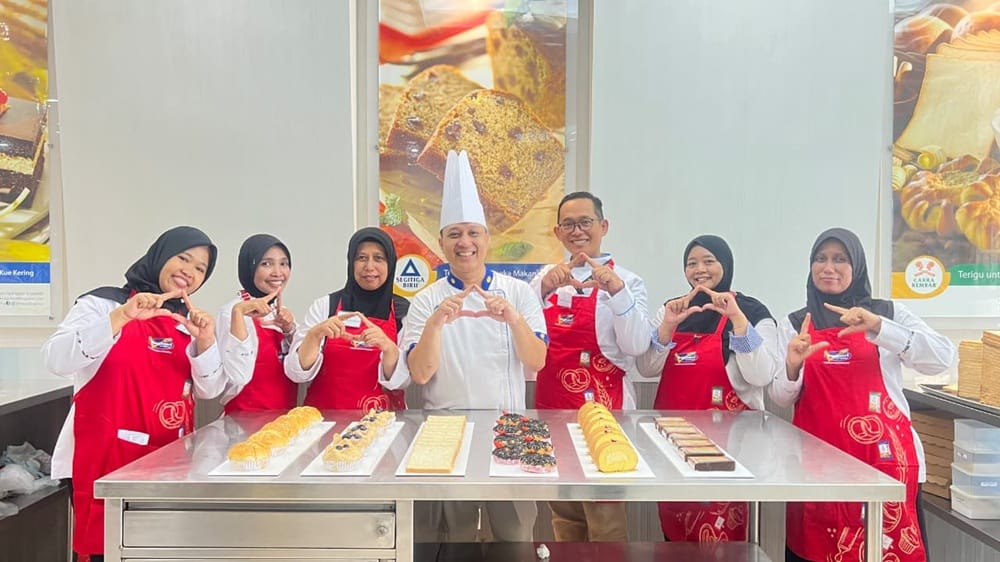
SURABAYA, Jakartaweekly.com — As part of a collaborative commitment to enhance the quality of culinary education, the Bogasari Baking Center (BBC) in Surabaya has once again provided specialized training for six culinary teachers from SMKN 3 Kediri. This two-day program, which took place on June 3-4, 2026, marks the second training session for the school’s faculty at the BBC.
Led directly by BBC senior chef Hadi Haudi , the recent session focused on a “Healthy Food Preparation” theme, specifically requested by the school’s administration. During the workshop, the educators were taught six distinct recipes: Whole Wheat Toast, Vegan Bread Blueberry Oat Milk Custard, Korean Garlic Cheese Bread, Cassava Tape Donut, Pumpkin Cotton Roll Cake, and Cassava Cake. The final three recipes purposefully incorporated local ingredients as a commitment to blending local wisdom with wheat-based baking.
This follows a previous session held on January 28-29, 2026, where a different group of six teachers learned “Contemporary Food” preparations , covering recipes like Bomboloni Mochi, Croissants, and Matcha Cotton Roll Cake. To date, a total of twelve SMKN 3 Kediri teachers have completed the training.
A Broader Educational Partnership
According to Bagus Tri Ardiyanto, Human Resource Manager for Bogasari’s Surabaya plant, a third batch of training is slated for later this year during the new semester. He noted in a June 5 press release that the themes will continue to align with the school’s teaching needs and its Teaching Factory (TEFA) product development.
The training is part of a broader one-year Memorandum of Understanding (MoU) between Bogasari and SMKN 3 Kediri. Other initiatives slated for this period include:
- Validation of the Project Based Learning curriculum through the Teaching Factory program.
- Implementation of teacher internship programs and student fieldwork practices (PKL).
- Hosting guest speakers to discuss the latest technology in the bakery industry.
- Organizing industry visits for both teachers and students.
Bagus expressed his hope that Bogasari will successfully fulfill all points of this mutual agreement before the partnership period concludes.
Translating Skills to the Classroom and Beyond
Agus Syafruddin, the teacher coordinator who has taught at SMKN 3 Kediri for 22 years, emphasized that the industry updates gained from the BBC will be passed down to the school’s 432 culinary students. The knowledge transfer will be implemented gradually, adapting the BBC materials to fit the curriculum of each grade level. For instance, Grade 11 students will focus on fusion pastry and bakery , while Grade 12 will study specialized bakery products for specific conditions, such as diet menus.
“Through this training, we teachers are grateful to Bogasari because we received many updates in pastry and bakery from the industry side,” Agus stated, noting the abundance of new techniques they acquired. “This is what the students must also know and master.”
The acquired knowledge will also fuel the school’s TEFA products. Under teacher supervision during the recent Ramadan, students successfully produced and sold directly to the public around 700 jars of assorted cookies, including nastar, chocochip, cat tongue, and caramel chocolate.
“Alhamdulillah, we managed to get a revenue of around Rp 35 million,” Agus shared. “But that is not the main thing, because the goal is more to train the students’ entrepreneurial spirit and skills. Because not everyone is able to go to college, they can also open a business.”
Looking forward, the school plans to expand its “Adiwangsa” TEFA brand with innovative products to attract consumers. Upcoming concepts include a “Buffet Donut” station where students sell fresh donuts on campus and buyers can customize their own toppings , as well as a highly popular “Healthy Noodle” dish made from a blend of wheat and spinach topped with spicy chicken.
Chef Hadi Haudi, who brings nearly two decades of wheat-based culinary experience, strongly supports the school’s specialized menu programs. He pointed out that Bogasari itself has developed numerous localized recipes, such as Flaky Taro, Purple Yam Donut, and Banana Brownies Cake.
“What is certain is that the advantage of wheat flour is that it is easy and has the potential to be processed with local archipelago foods,” Chef Hadi affirmed. “Wheat is very good for elevating the economic level of our local agricultural products.”
Discover more