Searching for Indonesia Behind Oesman Effendi’s Abstraction
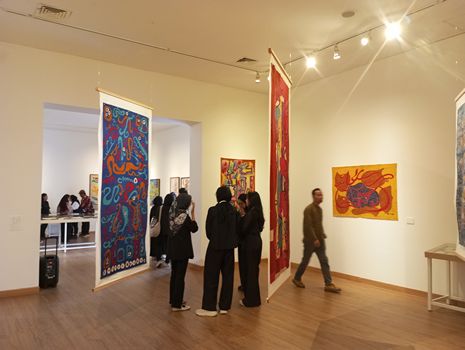
JAKARTA, Jakartaweekly.com — On Oesman Effendi’s canvases, mountains do not always look like mountains. Trees lose their recognizable forms, human figures dissolve into rhythms of lines, while colors move freely without attempting to imitate reality.
To some viewers, these paintings may appear to be nothing more than abstractions. Yet for Oesman Effendi—or OE—every line and every color carried a much larger question: what should Indonesian painting truly look like?
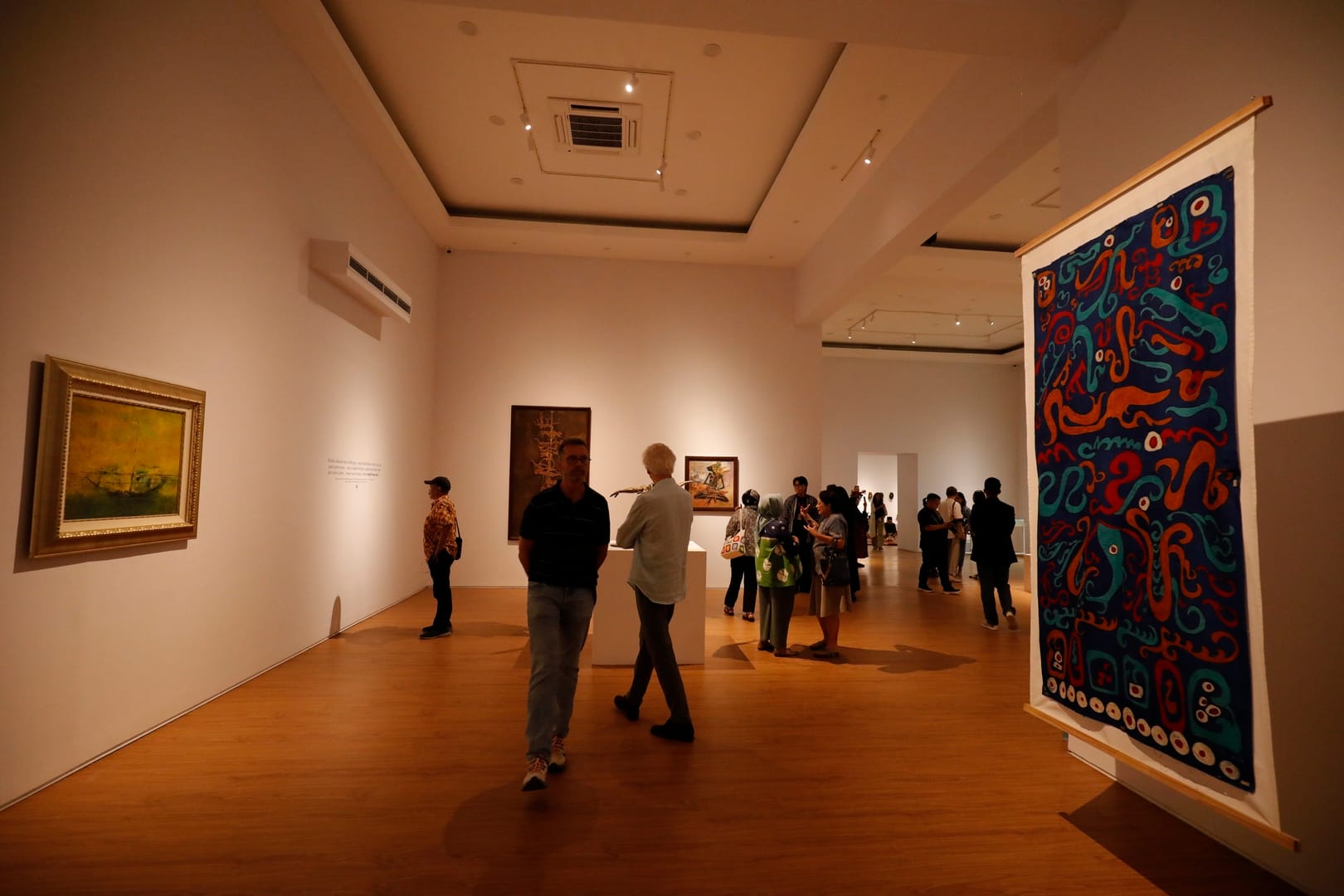
It was a question he never fully answered during his lifetime. Four decades after his passing, that search is being revisited through the exhibition OE: Archives and Works at the National Gallery of Indonesia.
Unlike a conventional retrospective, the exhibition goes beyond displaying dozens of paintings, archival materials, graphic works, and contemporary batik pieces.
Instead, visitors are invited into the intellectual world of an artist who spent decades attempting to define the identity of Indonesian art amid the tensions between Western modernism and the spirit of post-independence nationalism.
During the polarized Indonesian art scene of the 1950s through the 1970s, Yogyakarta became synonymous with social realism, while Bandung was associated with an academic and formalist approach. Jakarta, however, offered a more fluid artistic environment.
It was in Jakarta that OE developed a distinct visual language. Rather than adopting abstraction as an imitation of Western modern art, he treated it as a means of translating lived experience into a visual language rooted in inner consciousness.
Exhibition curator Aminudin TH Siregar describes OE as more than an abstract painter. He sees him as an art thinker who sought to bridge local experience with international modernism.
“What we are witnessing is essentially his proposal. If there is such a thing as a national school of painting, what would it actually look like?” Aminudin said.
According to him, OE offered an alternative to the artistic debates of his time. Instead of asking whether Indonesian art should be realistic, decorative, or abstract, he shifted the discussion toward a more fundamental question: how could the lived experiences of Indonesian society become the foundation of artistic creation?
This idea later evolved into OE’s concept of Inner Impression (Kesan Dalam). As explained in the exhibition’s curatorial text, a painting is not an imitation of reality but a reconstruction of experience processed through the artist’s memory, perception, and intuition.
In this framework, Indonesianness is expressed not through traditional ornaments or easily recognizable cultural symbols, but through the way an artist experiences and internalizes the world around them.
The concept did not emerge solely within the confines of a studio. To his family, OE was someone who loved walking through the city. Wherever he went, he almost always carried a sketchbook and a pen. Anything that caught his attention would be quickly noted or sketched before later being transformed on canvas.
“He was always doodling,” recalled Mersiana Setiarini, OE’s niece, referring to her uncle’s habit of making rapid sketches whenever something intrigued him.
Classical music accompanied him while he painted. Vinyl records continuously played in his studio, providing the soundtrack to creative sessions that often lasted for hours. Even decades after his death, family members have discovered tubes of his paint that have yet to completely harden.
Behind his public identity as a painter, OE was known as a quiet and reserved person. But with the right conversation partner, discussions could continue for hours, covering art, life, and philosophy.
“Whenever he met someone he connected with, the conversation would always revolve around art and life,” Mersi said.
OE also had a deep interest in traditional medicine and religious studies. He performed the Hajj pilgrimage several times, loved reading, and frequently shared advice with his family.
For his nieces and nephews, the gifts he most often gave were not expensive possessions but his own paintings.
After marrying in 1956, OE settled in Jakarta, following his wife, who worked at Bank Indonesia. The city became a defining space in his artistic journey. As Jakarta evolved into a growing metropolitan center, it offered experiences vastly different from the Minangkabau landscape where he had grown up.
Jakarta and OE’s Visual Language
According to Aminudin, life in Jakarta profoundly shaped OE’s visual sensibility. “To him, Jakarta was like a large village transforming into a city. An artist possesses the sensitivity to perceive that transformation,” he said.
That sensitivity gradually found expression in increasingly liberated forms. Mountains, people, animals, and plants slowly shed their literal appearances, becoming rhythms of lines, planes, and colors.
This simplification did not diminish meaning. Rather, it represented an effort to uncover the deepest structure of visual experience.
OE’s artistic journey also placed him at the center of one of the most significant debates in Indonesian art history.
In 1969, he argued that Indonesian painting, in fact, did not yet exist. What existed, he wrote, was Western painting practiced by Indonesian artists. The statement sparked fierce reactions, including from S. Sudjojono, widely regarded as the father of modern Indonesian painting.
Their debate unfolded through newspaper articles and became one of the most influential artistic discourses of its era.
According to Aminudin, the impact of OE’s ideas could still be felt well into the early 1990s. “People continued asking whether OE might actually have been right—that perhaps the visual language of Indonesian painting had not yet been discovered,” he said.
The statement emerged within the cultural politics of President Soekarno’s era, when artists were encouraged to search for a distinct “national identity.” For many artists at the time, the search for identity was not merely an artistic choice but also a cultural responsibility.
OE chose a different path. He rejected the idea of art as political propaganda, yet he also refused to simply imitate Western modernism. He studied the ideas of leading modern artists, read extensively, wrote art criticism, and developed his own theories about how an Indonesian visual language should evolve.
In the curator’s view, OE was among the few Indonesian artists who not only painted but also constructed a theoretical framework for their own artistic practice.
The traces of that intellectual journey are visible throughout the exhibition, from sketches and handwritten notes to archival documents displayed alongside his artworks. As such, the exhibition is not intended merely as a nostalgic tribute to a great painter, but as an invitation to revisit the thought process behind his creations.
“We hope this exhibition presents not only the artworks themselves, but also the artist’s process of thinking and his search for identity,” the curatorial team said.
In today’s rapidly evolving art world, the question Oesman Effendi posed more than half a century ago remains remarkably relevant. He never offered a definitive answer to what Indonesian art should ultimately become.
Instead, he left behind an ongoing search. And perhaps that is Oesman Effendi’s greatest legacy—not the abstractions that fill his canvases, but the courage to ask how Indonesia can exist in art without always having to be depicted literally.
Abstract ArtAminudin TH Siregarart exhibitionIndonesian ArtIndonesian Art HistoryIndonesian Modern ArtIndonesian PaintingNational Gallery of IndonesiaOEOesman Effendi
Discover more