When Leftover Materials Find a New Horizon at Art Jakarta
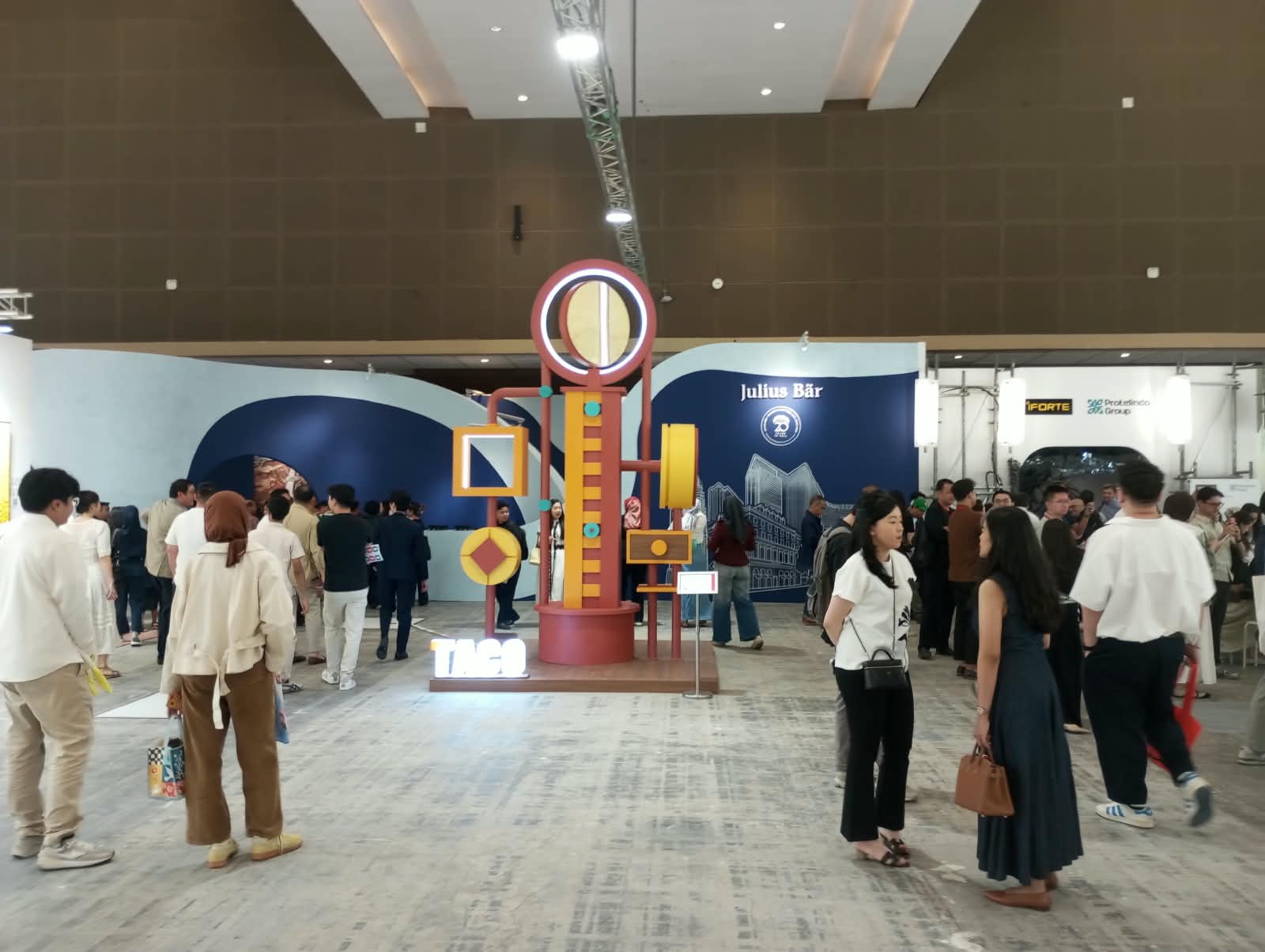
JAKARTA, Jakartaweekly.com — Standing prominently at the heart of the exhibition space, a terracotta-colored installation commands attention with its blend of retro geometric aesthetics and modern architectural articulation. Warm brick-red tones meet mustard yellow, metallic gold, and natural wood accents, forming a structure that at first glance resembles a mechanical machine from the future.
At the very top, a large terracotta circle frames a reflective gold disc at its center. A ring of white LED light surrounding it creates a visual focal point reminiscent of an eclipse or a futuristic sundial.
Below it, an orange vertical pillar with a stepped pattern serves as the installation’s central axis. The pillar is flanked by terracotta cylindrical structures at its base, while a series of geometric forms surround it. On the left is a square frame illuminated from within, accompanied by a yellow diamond-shaped module with a circle at its center.
On the right, a thick yellow cylindrical wheel sits beside a wood-textured box fitted with a circular lens. The form evokes a projection device or a mechanical instrument from another era.
Terracotta pipes weave through the structure, connecting one module to another. Their winding paths suggest flows of energy, ideas, or functionality, linking the various components into a single interconnected system.
The installation is The Curiosity Engine, a collaboration between TACO and Palette Studio presented at Art Jakarta 2026. Beneath its retro-futuristic appearance lies an exploration of curiosity and the possibility of seeing familiar things from a different perspective.
The work was developed by Aji Fajar, Founder of Palette Studio and an artist, in collaboration with TACO. Circles, squares, diamonds, pipes, and layered structures do more than shape the composition; together, they create a dialogue between modern interior materials and the symbolism of mechanical machines.
Wood textures, material surfaces, colors, and precisely controlled lighting reinforce the exploration of the relationship between surface and structure. Layered geometric forms give the installation the appearance of both a time-measuring instrument and a machine for observing and perceiving the world.
From this perspective, interior materials take on another possible meaning. They are no longer simply functional components of a space, but can also shape visual experiences and influence how people perceive their surroundings.
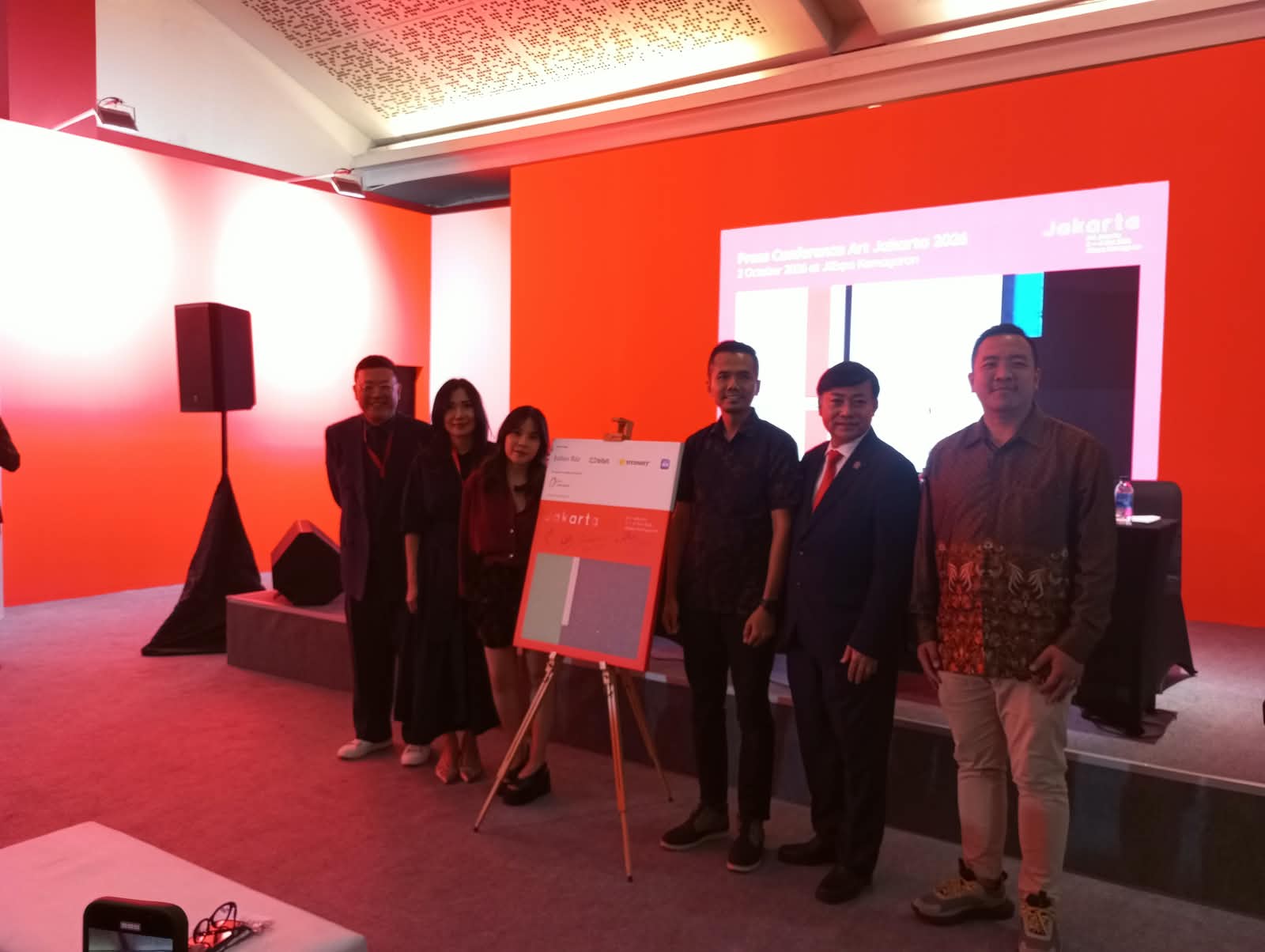
This idea lies at the heart of TACO’s participation in Art Jakarta 2026. Marking its sixth year at the art fair, TACO once again brings its Explore New Horizons spirit to the event, exploring how a shift in perspective can open up new possibilities.
“For us, Explore New Horizons is not only about discovering something new, but also about having the courage to look at familiar things from a different perspective,” said TACO Chief Marketing Officer Anastasia Tirtabudi.
For Aji, the creation of The Curiosity Engine also began with materials that were already available. The work incorporates several TACO materials, including TACO PVC sheet, drawer slide, PVC board, and waste or leftover TACO HPL materials.
“What we found interesting in the process was how existing materials could be viewed through different possibilities. We explored their characteristics and arrangements to find a composition that suited the idea we wanted to convey,” Aji said.
This is where the work brings artistic exploration together with the question of material use. Leftovers from the production process are not simply treated as materials that have served their purpose. Instead, they become part of the creation of a new work.
The approach is aligned with TACO’s commitment to zero waste. Materials left over from the production process are given another use and a new role within a work presented in a public art setting.
In this sense, the idea of finding a new horizon is not expressed solely through the installation’s visual form. It is also reflected in how the materials themselves are treated.
The circle at the top of the installation serves as its visual focal point. According to TACO, the element draws inspiration from the eye, compass, and sun—symbols of observation, the search for direction, and the beginning of a new cycle. Meanwhile, the other forms, colors, and textures retain elements that are already familiar.
This contrast encourages visitors to look again at things they may already know. A sheet of material, a texture, a color, or an interior component can take on a different meaning when placed within a new composition and context.
Art Jakarta Artistic Director Enin Supriyanto sees such collaborations as opening up new possibilities when everyday materials enter the world of art.
“Collaborations like this allow familiar materials from everyday life to be presented through a different approach, bringing art, design, and space into closer conversation,” Enin said.
The exploration continues through TACO’s participation in the Jakarta Illustration and Creative Arts Fair (JICAF), now in its third year, through the Live Mural Powered by TACO activation.
Four local and international mural artists—Jaekwang Park, Muklay, Mbetand, and Maito Parta—use TACO HPL as their medium. Starting with the same material, each artist interprets it through a distinct visual language and creative perspective.
Together, the two initiatives demonstrate a similar approach: material becomes a starting point for the creative process rather than the final boundary of its function.
For TACO, collaborating with artists and creative practitioners is one way to explore the broader role that materials can play. Materials are not only components of products or spaces; they can also become a medium for creating experiences and opening up new ways of seeing.
Ultimately, The Curiosity Engine conveys a simple idea through a complex form: a new horizon does not always have to be found in something entirely new. Sometimes, it emerges from what is already there when curiosity invites us to look at it differently.
Discover more