
Perry Warjiyo Resigns, Economists See No Reason to Worry About BI Policy
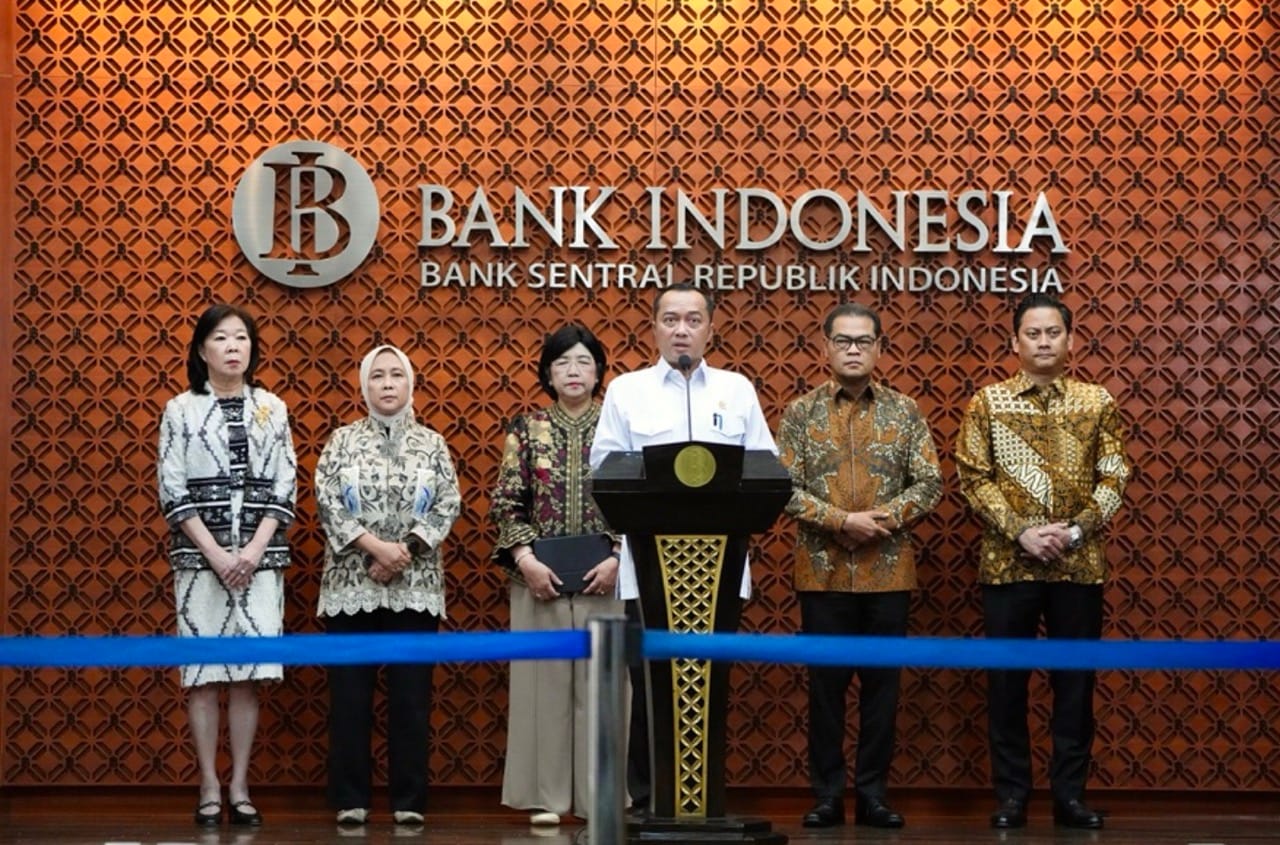
JAKARTA, Jakartaweekly.com—The government has accepted the resignation of Perry Warjiyo as Governor of Bank Indonesia (BI). Despite the leadership transition, economists believe the central bank’s policy direction will remain unchanged, as Senior Deputy Governor Destry Damayanti is set to serve as Acting Governor in accordance with prevailing regulations.
Permata Bank Chief Economist Josua Pardede said Perry Warjiyo played a significant role in strengthening Indonesia’s policy mix, expanding exchange rate stabilization instruments, deepening the financial market, and integrating monetary policy, banking policy, and the payment system.
Furthermore, Josua emphasized that Perry Warjiyo’s resignation should be viewed as an orderly leadership transition rather than a leadership vacuum at Bank Indonesia.
“Overall, Perry Warjiyo’s resignation should not trigger excessive concern,” Josua told Jakarta Weekly on Tuesday, July 27, 2026.
According to Josua, Bank Indonesia operates under a clear legal framework, with the Board of Governors working collectively using a comprehensive policy framework. Policy continuity remains intact because the central bank’s decisions do not depend on a single individual. The Board of Governors Meeting is the highest decision-making body for strategic and fundamental policies, with decisions reached through deliberation among all board members.
As a result, decisions on interest rates, liquidity management, foreign exchange intervention, and payment system regulation are institutional decisions implemented collectively rather than personal decisions made by the Governor.
From a legal standpoint, the transition mechanism is also clearly stipulated. When the Governor’s position becomes vacant and a permanent successor has not yet been appointed, the Senior Deputy Governor assumes the Governor’s duties as Acting Governor. Moreover, the appointed Acting Governor has extensive experience in Indonesia’s financial markets.
Therefore, the key message for businesses and investors is that there is no leadership vacuum, no change to Bank Indonesia’s mandate, and no reason to expect sudden shifts in exchange rate policy or financial market management.
“On a personal level, Perry Warjiyo’s decision to step down and take a well-deserved rest deserves respect. He joined Bank Indonesia in 1984 and has served the institution for approximately 43 years, rising from a staff member to serving two terms as Governor,” Josua told Jakarta Weekly on Monday, July 27, 2026.
Josua added that after more than four decades of service, Perry Warjiyo’s resignation should be interpreted as the conclusion of a long period of public service rather than an indication of any weakness in Bank Indonesia’s ability to carry out its responsibilities.
Teuku Muhammad Riefky Hasan, a Macroeconomics and Financial Markets Researcher at LPEM FEB UI, also noted that Perry Warjiyo’s resignation has not triggered a negative market reaction. Looking ahead, he hopes the leadership transition will not undermine investor confidence in Indonesia.
“Since the acting governor comes from within Bank Indonesia, we see the central bank maintaining the same policy direction, so there should be no drastic changes,” Riefky said.
However, to preserve investor confidence, Bank Indonesia must continue assuring investors that it remains committed to maintaining exchange rate stability, controlling inflation, and safeguarding its institutional independence.
Destry Damayanti to Serve as Acting BI Governor
Josua believes Destry Damayanti is well prepared to ensure policy continuity at Bank Indonesia, particularly given her extensive experience in Indonesia’s financial sector and within the central bank itself.
Destry has served as Senior Deputy Governor since 2019 and is currently in her second term, which runs through 2029. Before joining Bank Indonesia’s leadership, she held positions at Citibank Indonesia, Mandiri Sekuritas, Bank Mandiri, the Ministry of State-Owned Enterprises, and the Indonesia Deposit Insurance Corporation (LPS).
“Her professional track record demonstrates a deep understanding of market participants, capital flows, banking, securities markets, and investor expectations. At Bank Indonesia, her responsibilities have also included the development of the money market and foreign exchange market, as well as maintaining rupiah stability. Therefore, the way Bank Indonesia assesses market conditions and manages the rupiah is unlikely to change abruptly,” Josua explained.
Policy continuity is also supported by the institutional framework already in place. In July 2026, the Board of Governors maintained the benchmark interest rate at 5.75%, while continuing policies aimed at strengthening the rupiah, maintaining the inflation target, improving liquidity, and attracting foreign capital inflows.
Bank Indonesia has also continued intervening in the foreign exchange market, managing money market interest rates, ensuring adequate banking liquidity, and expanding hedging facilities for investors. These policy tools are embedded within the central bank’s institutional framework and can continue to be implemented under Destry’s leadership.
Nevertheless, continuity does not mean the transition is without risks. According to Josua, financial markets will closely monitor three key factors: the consistency of Bank Indonesia’s communication, its commitment to maintaining independence, and the certainty surrounding the appointment of a new permanent Governor.
Bank Indonesia should promptly reaffirm that its inflation target, rupiah stabilization strategy, and interest rate decisions will continue to be based on economic data and evolving risks. At the same time, the government should make it clear that the appointment process for the next Governor is not intended to influence the central bank to cut interest rates or finance government policies.
“The biggest challenge is not Destry’s ability to carry out the role, but ensuring that the leadership transition is communicated quickly, consistently, and convincingly,” Josua concluded.
Discover more