
AirNav and Boeing Study Ways to Ease Aircraft Congestion at Ngurah Rai Airport
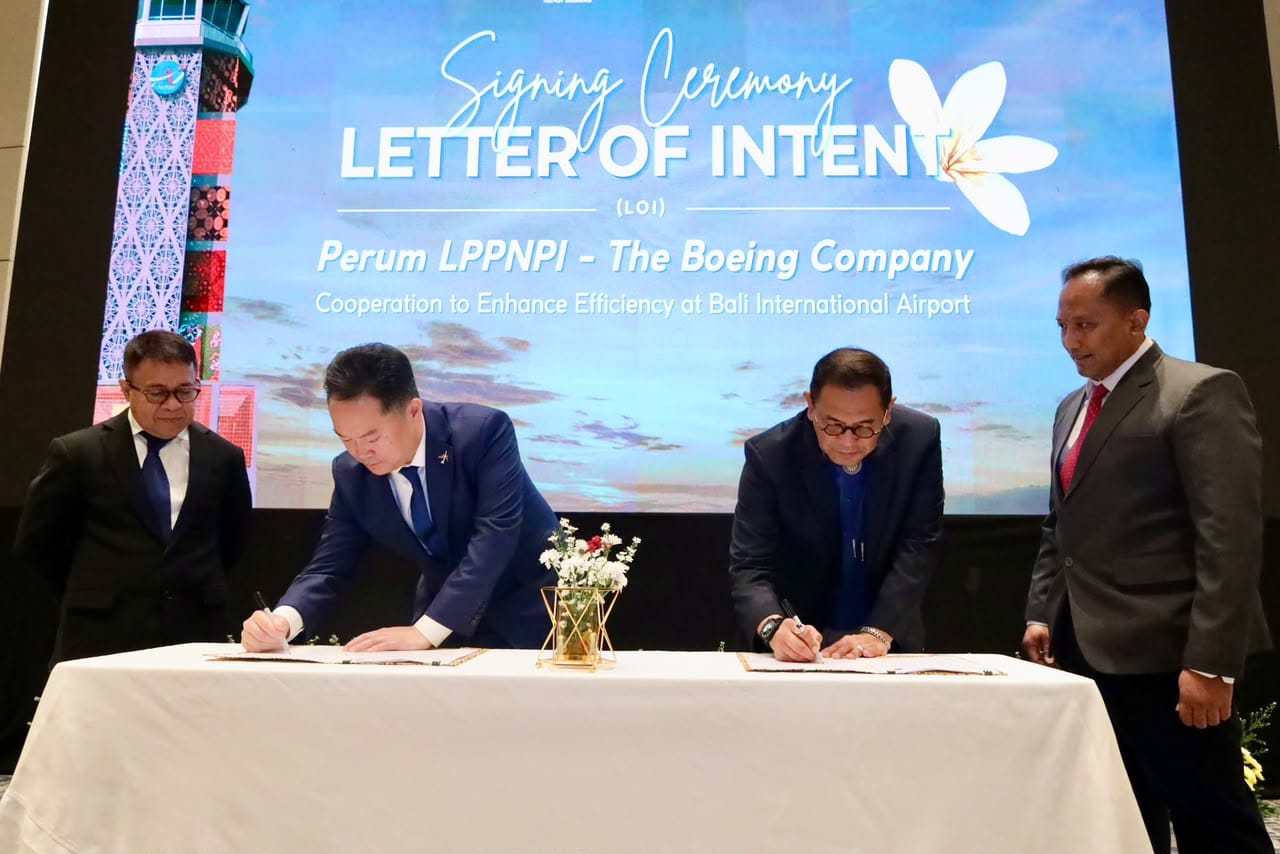
TANGERANG, Jakartaweekly.com — AirNav Indonesia and The Boeing Company have signed a Letter of Intent (LoI) to study ways to optimize aircraft movement operations at I Gusti Ngurah Rai International Airport in Bali. The study aims to identify ways to reduce congestion in aircraft ground movements while improving runway utilization.
The LoI was signed by AirNav Indonesia President Director Capt. Avirianto Suratno and Boeing Commercial Airplanes Senior Managing Director Malcolm An at the Sheraton Jakarta Soekarno-Hatta Airport Hotel in Tangerang on Tuesday (Sept. 15, 2026).
Avirianto said the study will begin by mapping the airport’s current operating conditions before testing several alternatives through modeling using the Total Airspace and Airport Modeller (TAAM).
“We are looking not only at current operating conditions, but also at various options that could make aircraft movements more efficient. Each option will be tested through modeling and simulation so that the resulting recommendations are supported by a strong analytical basis,” Avirianto said.
In the initial stage, AirNav and Boeing will develop a TAAM baseline model representing current operations at Ngurah Rai Airport. The model will use a 24-hour flight schedule representing normal airport operations.
The modeling will cover east flow and west flow, two operating configurations based on the direction of aircraft movements. The modeling will produce operational statistics as well as four-dimensional (4D) visualizations.
The study will also include on-site observations at Ngurah Rai Airport. AirNav and Boeing will involve Subject Matter Experts (SMEs) from air traffic control, airport operations, airlines, ground handling, and airport planning.
The observations may cover several facilities, including the ATC tower, terminal radar facilities, ground-handling operations centers, airline operations centers, airport planning and development units, and airside areas.
Once the baseline model has been validated using AirNav Indonesia’s operational data, the two parties will develop several alternatives to improve operational efficiency.
The alternatives may cover aircraft ground-movement layouts and procedures, the use of taxiways and aircraft parking areas, as well as movement sequencing and coordination between operational units.
“The alternatives will then be tested through TAAM simulations. Boeing is expected to model up to three scenarios to assess the performance of each option before they are considered for implementation,” Avirianto said.
The modeling will also use at least two additional schedules representing projected growth in air traffic. Each scenario will be tested under both aircraft movement flow directions based on operational assumptions agreed upon by the two parties.
The modeling and simulation results will serve as the basis for recommendations to improve aircraft movement operations at I Gusti Ngurah Rai International Airport.
Continuation of Partnership Dating Back to 2023
The cooperation is a continuation of a Memorandum of Understanding (MoU) signed by AirNav Indonesia and Boeing in 2023.
The MoU established a framework for cooperation in airspace management, training, and strategic air traffic management planning.
Boeing Indonesia Managing Director Indra Duivenvoorde said the study combines Boeing’s expertise in aircraft performance and air traffic management with AirNav Indonesia’s operational experience.
He said the study is intended to produce practical, data-driven measures to improve traffic flow, enhance runway utilization, and support safe, efficient, and sustainable air travel in Bali.
“We see Indonesia as one of the largest aviation markets in Asia and are committed to our partnership with AirNav Indonesia and the national civil aviation industry,” Indra said.
Discover more