Food and Beverage Industry Exports Targeted to Reach US$83 Billion by 2029
JAKARTA, Jakartaweekly.com—Indonesia’s Ministry of Industry (Kemenperin) projects the country’s food and beverage industry exports to reach US$83 billion by 2029. The target is expected to be supported by greater downstream processing, higher industrial capacity utilization, and expanded export markets.
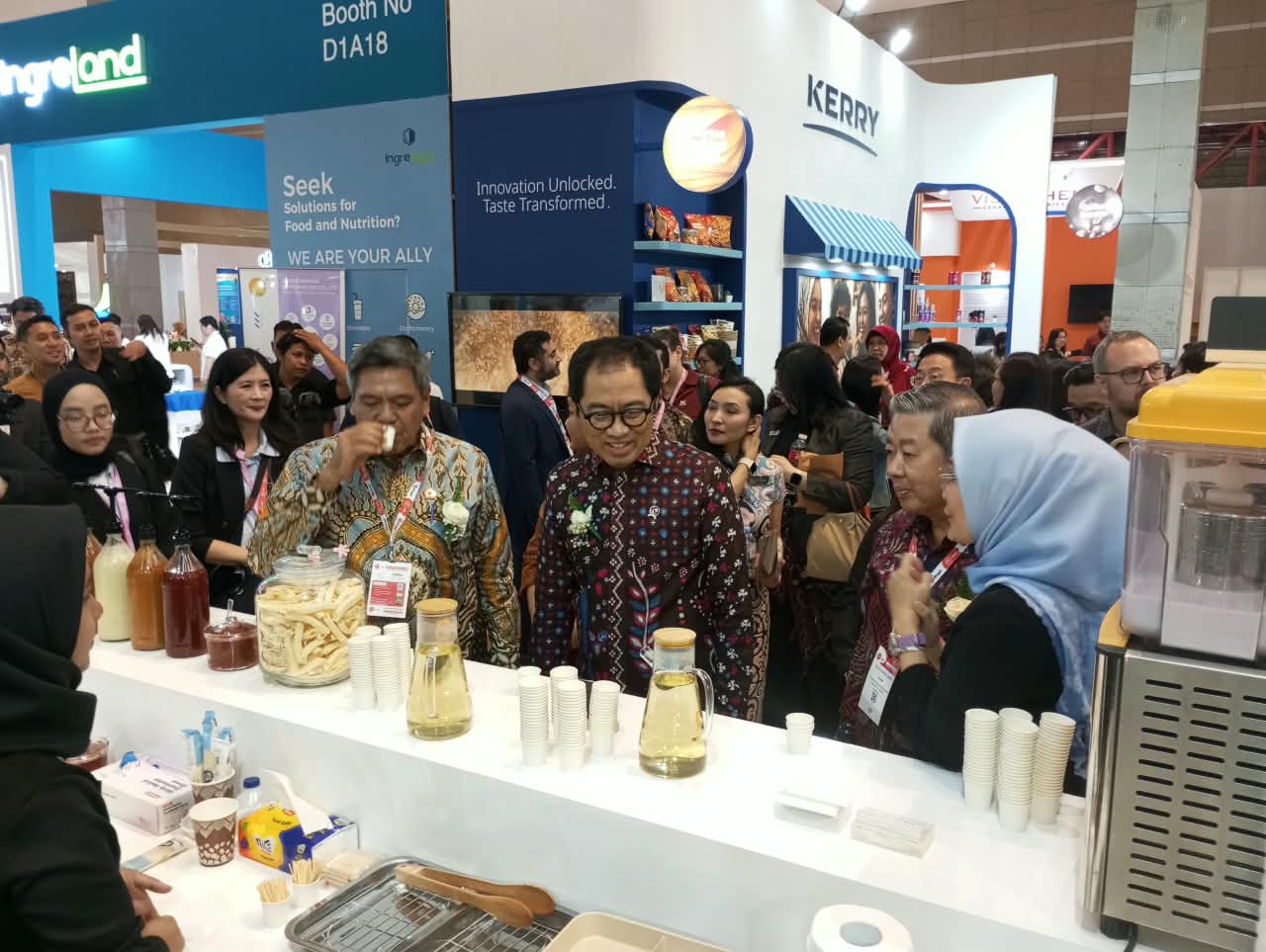
Deputy Minister of Industry Faisol Riza announced the target while opening Food Ingredients Asia Indonesia 2026 at the Jakarta International Expo on Wednesday (Sept. 16, 2026).
According to Faisol, Kemenperin projects food and beverage industry exports to grow at a compound annual growth rate (CAGR) of 10.9% through 2029.
“Indonesia’s food and beverage industry exports are projected to grow rapidly to reach US$83.0 billion by 2029, with a CAGR of 10.9%,” he said at the opening of Food Ingredients Asia Indonesia 2026 on Wednesday, Sept. 16, 2026.
To achieve the target, Kemenperin has set several strategic objectives for the national food and beverage industry. One of them is to increase industrial capacity utilization to 70%.
Kemenperin also aims to increase the proportion of downstream products in exports and expand market access to 20 new export destination countries.
The market expansion will focus primarily on nontraditional markets with high potential, including North America, South America, Eastern Europe, the Middle East, and South Asia. Kuwait and Uruguay are also among the targeted markets.
Food and Beverage Exports Reach US$49.5 Billion in 2025
Faisol said the performance of Indonesia’s food and beverage industry has shown a positive trend. In 2025, exports of food and beverage products reached US$49.5 billion, the highest level in the past five years. During the same period, food and beverage trade recorded a surplus of US$36.1 billion.
Export performance was supported by several major commodities, including palm oil, fishery products, margarine, and processed cocoa.
Meanwhile, food and beverage imports stood at US$13.4 billion in 2025. Imports included processed food products and industrial raw materials such as oilcake and residues, milk powder, and meat.
The positive trend continued in the first half of 2026. Food and beverage exports reached US$24.61 billion, generating a trade surplus of US$17.67 billion.
“Therefore, investor confidence in the sector’s prospects remains strong,” Faisol said.
Investment Reaches Rp26.82 Trillion
Optimism surrounding the food and beverage industry is also reflected in investment realization. Faisol said investment in the food and beverage industry reached Rp26.82 trillion in the first half of 2026.
Beyond investment, the food and beverage industry also plays a significant role in employment. The sector employs around 6.94 million workers, or approximately 34.72% of Indonesia’s total workforce.
At the same time, the government remains alert to global challenges that could affect the food and beverage industry, ranging from geopolitical uncertainty and supply chain disruptions to increasingly stringent international trade standards.
These challenges include environmental regulations and deforestation issues, stricter food safety standards, and changes in consumer behavior.
Kemenperin Strengthens Mandatory SNI Implementation
In response to these changes, Kemenperin is strengthening the implementation of mandatory Indonesian National Standards (SNI) for a number of industrial products.
The measure is intended to ensure health, safety, security, and environmental sustainability while improving the competitiveness of Indonesian products in global markets.
Products already covered by mandatory SNI regulations include wheat flour, bottled drinking water, palm cooking oil, instant coffee, primary packaging, paperboard, cocoa powder, cornstarch, non-dairy creamer, and refined crystal sugar.
According to Faisol, improving food standards is not only about regulatory compliance but also serves as a foundation for the future development of the food industry.
“Raising food standards is not merely administrative compliance, but the foundation of future food industry development,” he said.
He identified three main reasons why food standards are becoming increasingly important: consumer protection, adaptation to global healthy food trends, and opening access to global markets.
Manufacturing Supports Economic Growth
Faisol further said Indonesia’s economic fundamentals remain strong. In the second quarter of 2026, the national economy grew 5.29%, while non-oil and gas manufacturing grew 5.3%.
From January to June 2026, non-oil and gas manufacturing accounted for 82.03% of total national exports, equivalent to approximately US$115.50 billion.
As of the second quarter of 2026, 14 of the 15 manufacturing subsectors recorded positive growth. The only subsector to contract was the rubber and plastic goods industry.
Meanwhile, the food and beverage industry was among the subsectors that recorded growth above the average for Indonesia’s non-oil and gas manufacturing industry.
Faisol added that, based on 2025 Manufacturing Value Added (MVA) data released by the World Bank, Indonesia’s manufacturing value added reached US$275.61 billion. The figure ranked Indonesia 12th globally and first in Southeast Asia.
Discover more