BofA: Indonesia’s Economic Growth to Remain Moderate in 2026
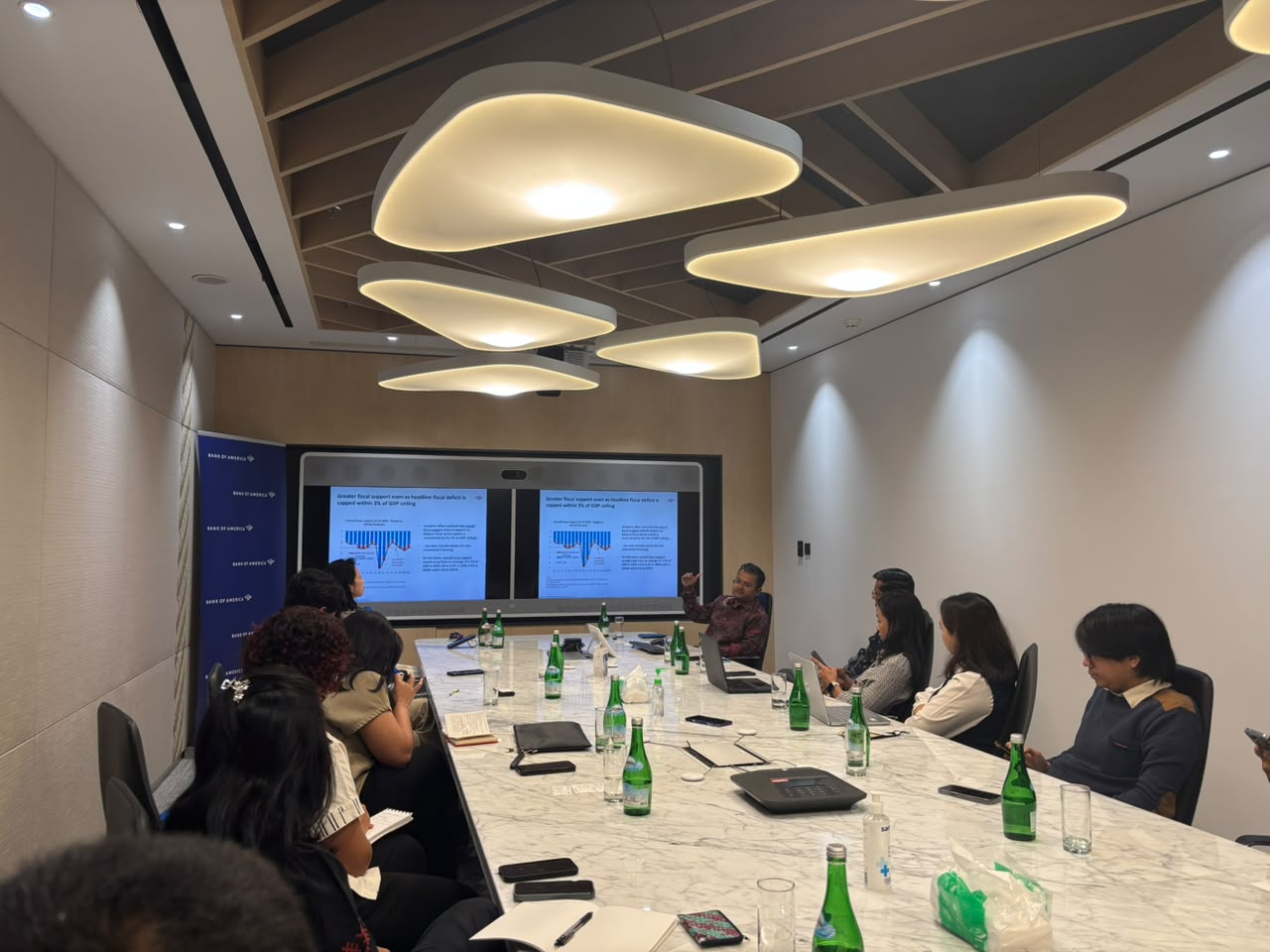
JAKARTA, Jakartaweekly.com — Bank of America (BofA) expects Indonesia’s economic growth to improve gradually as fiscal policy begins to have a greater impact on consumption and investment. However, growth is expected to remain moderate, without a sharp acceleration.
Bank of America Head of India & ASEAN Economics Rahul Bajoria said Indonesia’s macroeconomic conditions were continuing to move in a better direction, with slightly higher growth and relatively lower inflation.
“Overall, we see a mild recovery and continued growth,” Rahul said in Jakarta on Wednesday, October 7, 2026.
According to Rahul, BofA broadly agrees that Indonesia’s economic growth will gradually improve as fiscal policy becomes more effective. The impact is beginning to be seen in consumption and investment, which have started to improve.
Rahul said consumption growth was also beginning to strengthen. He noted that car sales had increased, while the performance of consumer goods companies had improved slightly. Meanwhile, credit growth has also picked up, partly driven by higher borrowing by state-owned enterprises.
According to Rahul, increased availability of funds and stronger deposit growth have also begun to emerge. However, he said fiscal policy takes time to have a broader impact, particularly when the government is making changes to corporate operations and implementing reforms.
On the fiscal deficit, Rahul said BofA expects Indonesia’s deficit to decline next year, but not by as much as the government expects.
He said the government’s target is 2.4%, while BofA sees a continued need to cover some shortfalls in oil company revenues because of the government’s policy of preventing state-owned enterprises from raising fuel prices.
Rahul also discussed the difference between fiscal deficits of 2.9% and 3.1%. He said the two figures were essentially not very different and that this view was in line with S&P’s assessment.
“As long as the quality of spending is not an issue, we agree with S&P that 2.9 and 3.1 are basically the same numbers,” Rahul said.
According to Rahul, the more important issue is where the funds are being spent and how much impact they have on economic growth.
“As long as growth picks up and the policies are not just very short-term, that’s okay,” he said.
Rahul also said Indonesia’s debt-to-GDP ratio of around 41%–42% was not, in itself, a problem.
“As long as it is not inflationary and the quality of spending is good, we are comfortable with a somewhat wider deficit,” he said.
However, he emphasized that the quality of government spending remains important over the long term.
On monetary policy, BofA does not expect Bank Indonesia to raise interest rates again under its base-case scenario. Rahul said that if the US Federal Reserve raises rates more than expected, Bank Indonesia may need to reconsider its policy.
On the exchange rate, BofA expects the US dollar to remain relatively strong over the next two to three months. Higher oil prices and US interest rates are among the factors supporting the dollar in the short term.
BofA expects the US dollar to trade at around Rp18,000 against the rupiah by year-end. Rahul also expects Bank Indonesia to remain present in the market to support rupiah stability.
On inflation, Rahul said conditions could improve as the effects of El Niño fade. Lower oil prices in the second half of next year are also expected to reduce costs for products such as petrochemicals, plastics, and packaging.
Rahul said BofA does not expect Indonesia’s potential growth rate of 6% to be reached in the near term. He also agreed with the central bank’s assessment that there is still some slack in the economy, meaning inflation is not a major concern.
Rahul also highlighted the incremental capital output ratio (ICOR), which has been part of the discussion in Indonesia. He said capital-use productivity could gradually improve as the effectiveness of government programs increases.
He said changes in fiscal policy and reforms take time to produce an impact, unless the government implements cash transfers, which can have a more immediate impact on the public.
Rahul also said Indonesia has stricter fiscal management rules than some other countries in the region. He compared Indonesia with Malaysia, which has a fiscal deficit of around 4%–4.5% but continues to receive positive assessments from rating agencies.
According to Rahul, the increase in Indonesia’s deficit after the pandemic should be viewed in a longer-term context. He said the deficit had increased materially after the pandemic, but the situation was not unprecedented.
He also noted that during the previous administration, state-owned enterprises were used to increase borrowing and government spending. On a consolidated basis, he said there was precedent for using such instruments to support spending.
Rahul said that as long as government spending is of good quality, a higher deficit within certain limits remains acceptable.
Meanwhile, Bank of America Indonesia Country Executive Mira Arifin said continued interest from US companies in investing in Indonesia was evident at the AmCham Investment Summit, which was sponsored by BofA.
According to Mira, several ministers and business leaders attended the event. She also mentioned discussions on investment in the data center sector and the presence of senior executives from US companies.
Mira said challenges still facing investors include greater certainty over the ease of doing business, licensing processes, program implementation and approvals, as well as certification costs.
According to her, investors compare these processes with those in other countries, while Indonesia sometimes has more stringent requirements and procedures.
Mira also said speed was becoming increasingly important as technology advances. She highlighted the need to respond to cyberattacks, carry out system updates, and address potential threats more quickly.
According to Mira, sectors that continue to attract investment include healthcare, technology, and consumer products.
Macro Forecasts
| Indicator | Units | 2025 | 2026E | 2027E |
| GDP | % | 5.1 | 5.3 | 5.5 |
| Inflation (average) | % | 1.9 | 3.3 | 3.0 |
| Current account | % of GDP | -0.1 | -1.8 | -1.1 |
| Fiscal balance | % of GDP | -2.8 | -2.9 | -2.7 |
| Policy rate (end of period) | % | 4.75 | 5.75 | 5.75 |
| USD/IDR (end of period) | IDR per USD | 16,700 | 18,000 | 18,200 |
Discover more