Bank Indonesia Raises BI Rate by 25 Bps to 6% Amid Rupiah Pressure
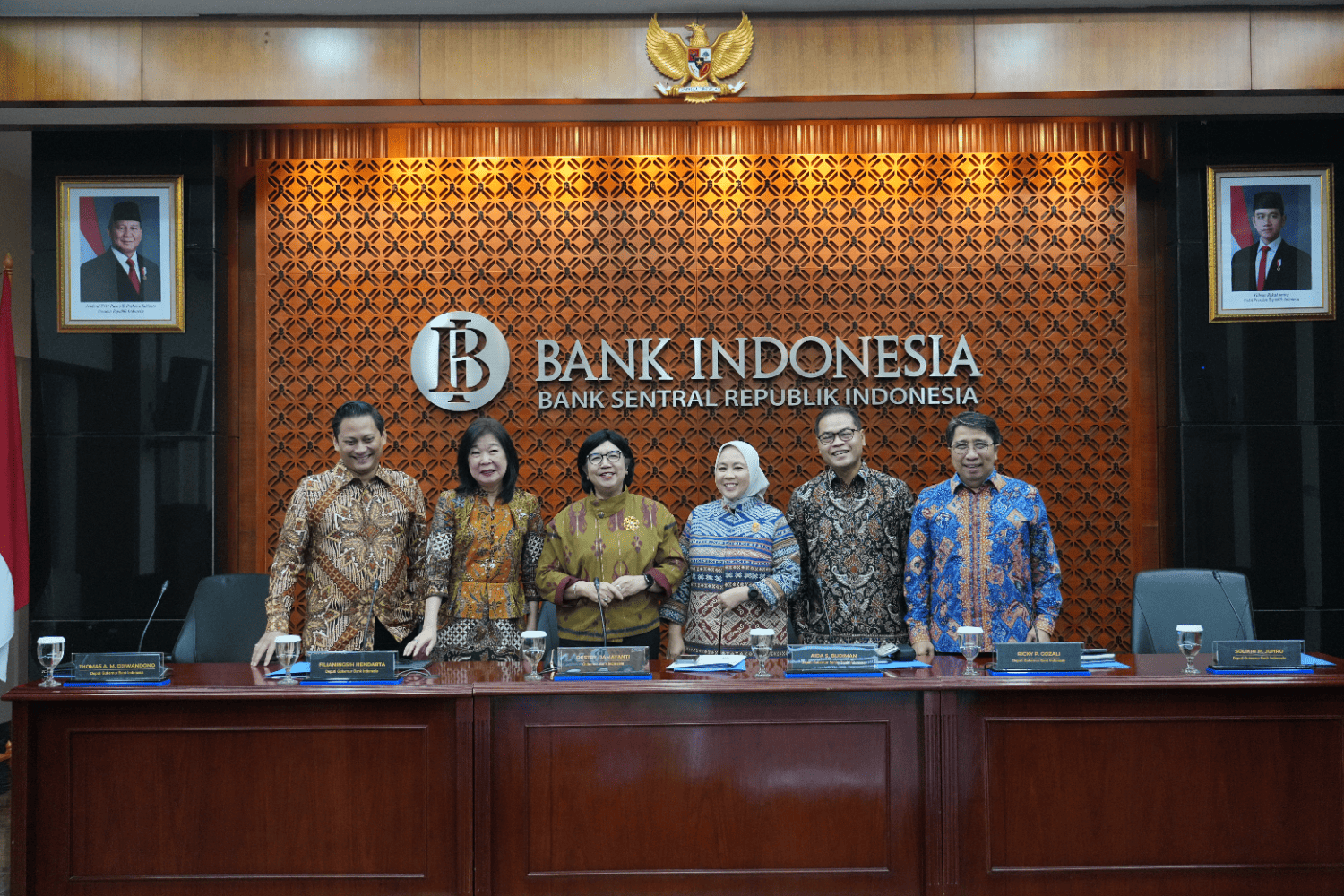
JAKARTA, JakartaWeekly.com—Bank Indonesia’s (BI) Board of Governors Meeting (RDG) decided to raise the BI Rate by 25 basis points (bps) to 6% on Wednesday, November 18, 2026. BI also increased its deposit facility and lending facility rates by 25 bps each, to 5.25% and 6.75%, respectively.
The rate hike is a response to rising global uncertainty and an effort to maintain the Rupiah’s stability. It also serves as a pre-emptive measure to keep inflation within the target range of 2.5%.
For context, the Rupiah weakened by 0.66% point-to-point (ptp) as of November 17, 2026, to Rp18,245 per US dollar, compared with its position at the end of October 2026.
“Going forward, Bank Indonesia will continue to consistently direct its monetary policy toward strengthening Rupiah exchange rate stability to ensure that inflation remains within its target range,” BI Governor Destry Damayanti said.
BI assessed that persistent global economic uncertainty had increased volatility in global financial markets. Ongoing geopolitical tensions in the Middle East, coupled with widening political instability in Europe, have kept global oil and commodity prices elevated.
Global economic growth in 2026 is projected to remain weak at around 3.1%, while inflationary pressures are expected to stay high at approximately 4.6%.
As a result, tight global monetary policies are expected to continue, including the possibility of an increase in the United States (US) benchmark interest rate, the Federal Funds Rate (FFR). US Treasury yields have also remained elevated amid expectations of higher FFR and the US government’s large fiscal deficit.
Financial market risks have also increased due to concerns over excessive valuations of Artificial Intelligence (AI) companies’ stocks. These developments have prompted global investors to reduce their portfolio investments in Emerging Markets, while keeping the US dollar index (DXY) relatively strong against both developed and emerging market currencies.
“These conditions require stronger policy responses and greater fiscal and monetary policy coordination to maintain macroeconomic stability, strengthen external resilience, and support domestic economic growth,” she explained.
Indonesia’s economy still solid but growth needs to be further strengthened
Domestically, BI assessed that Indonesia’s economy maintained solid growth of 5.47% year-on-year (yoy) in the third quarter of 2026. However, growth needs to be further strengthened amid persistently weak global economic conditions.
Meanwhile, Destry said recent developments indicated that economic growth in the fourth quarter of 2026 remained solid, supported by continued government fiscal stimulus that boosted household consumption alongside improving consumer expectations.
Investment also remained resilient, supported by a greater contribution from private investment, in line with an increase in the Manufacturing Purchasing Managers’ Index (PMI) from 52.40 in September 2026 to 53.98 in October 2026. On the external front, export performance needs to be further strengthened, including non-oil and gas exports, to capitalize on rising commodity prices.
BI projects Indonesia’s economic growth in 2026 to remain within the range of 4.9%–5.7%.
Indonesia’s Balance of Payments (BOP) continued to record a surplus of US3.36 billion as of September 2026, although this was slightly lower than the US3.55 billion surplus recorded in August 2026. BI therefore considered it necessary to further strengthen the BOP to support external resilience.
Indonesia’s foreign exchange reserves stood at US$146.8 billion at the end of October 2026, equivalent to 5.3 months of imports or 5.2 months of imports and government external debt repayments. This level remains above the international adequacy standard of around three months of imports.
Meanwhile, accommodative macroprudential policies will continue to be strengthened to encourage lending and financing to the real sector while maintaining financial system stability.
BI Rate hike seen as evidence of commitment to monetary stability
Capital market practitioner and PasaRDana Co-founder Hans Kwee explained that BI’s decision to raise interest rates was driven by external pressure on the Rupiah.
Hans noted that by mid-November 2026, the Rupiah had depreciated to record lows in the range of Rp18,250–Rp18,300 per US dollar.
The depreciation was driven by a stronger US dollar index, which had reached its highest level in the past 19 months; market expectations of more than 90% that the Federal Reserve (the Fed) would raise interest rates again at its December 9, 2026, meeting; and 10-year US Treasury yields remaining above 5.13%.
“Furthermore, foreign capital outflows ahead of the MSCI and FTSE index adjustments at the end of this month, along with the risk of imported inflation due to currency depreciation, provide strong arguments for those expecting an interest rate hike,” he explained.
On the other hand, Hans observed that inflation in October 2026 remained under control at 3.23%, within BI’s target corridor of 2.5% ± 1%. At this inflation level, Indonesia’s real interest rate spread had reached 2.52%, making it one of the highest in Southeast Asia.
In addition, global crude oil prices (Brent and WTI) had begun to ease to around US88–US96 per barrel, following projections of a global supply surplus from the International Energy Agency (IEA). This has helped ease direct pressure on energy subsidies and administered-price inflation.
Furthermore, Hans considered that the interest rate hike could have a positive impact on the stock market in the medium term.
“Although, in theory, higher interest rates increase borrowing costs, a measured 25-bps hike amid the Rupiah’s record depreciation will be viewed by global investors as evidence of BI’s firm commitment to maintaining monetary stability,” he explained.
The accompanying Rupiah appreciation would help ease concerns over foreign investor outflows and restore market confidence in domestic risk assets.
Hans also explained that the rate hike could potentially put pressure on net interest margins (NIM) due to higher funding costs. However, maintaining Rupiah stability is crucial to preventing foreign capital outflows from the country’s four major banks: BBCA, BBRI, BMRI, and BBNI.
Nevertheless, given the relatively high NIMs of major banks, a 25-bps increase is unlikely to have a significant impact on their corporate performance. In general, banking stocks tend to respond neutrally to positively when BI raises its benchmark interest rate.
For the property, automotive, and technology sectors, Hans assessed that higher interest rates could lead companies to postpone expansion plans and put pressure on technology stock valuations.
Discover more