Mudik 2026: Why Indonesia Must Shift Travelers from Private Vehicles to Public Transport
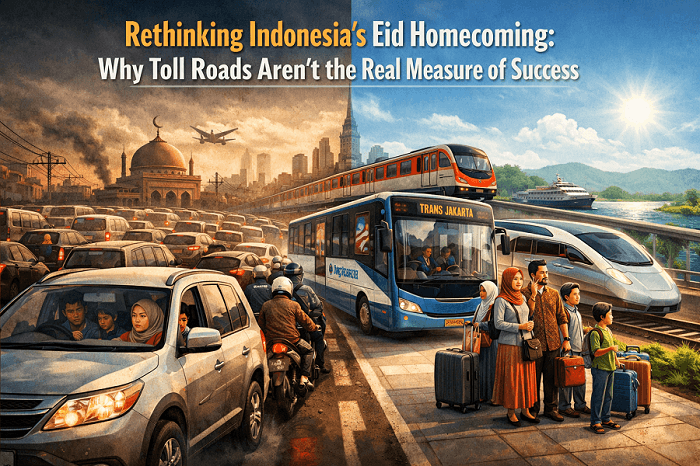
The face of Indonesia’s Eid homecoming migration (mudik) has undergone a major transformation with the massive development of toll road infrastructure. However, behind the smooth asphalt lies a new challenge: redefining what true success for the annual migration actually means.
According to the 2026 Eid Transportation Survey conducted by the Ministry of Transportation together with the Central Statistics Agency (BPS), the Ministry of Communication and Digital Affairs, and LAPI ITB, an estimated 143.9 million people are expected to travel during the holiday period.
Interestingly, the majority of travelers still rely on private vehicles, accounting for 69.72 percent or 100.32 million people. Among them, private cars dominate at 52.98 percent, followed by motorcycles at 16.74 percent.
For public transportation, buses remain the most popular option with 16.22 percent (23.34 million passengers), followed by ferry crossings at 4.45 percent (6.40 million) and air travel at 3.46 percent (5.98 million). The remaining share includes intercity trains (3.33 percent / 4.79 million), urban rail (1.51 percent / 2.17 million), sea transport (0.64 percent / 926,000), and high-speed rail (0.47 percent / 682,900).
For years, the success of the Eid homecoming has been measured by how well road users’ comfort, security, and safety are maintained. By those standards, the results have improved significantly, with higher satisfaction levels and declining accident rates.
Since the Trans-Java Toll Road connected Jakarta to Surabaya, traffic during the homecoming season has become considerably smoother. Traffic engineering measures such as contraflow and one-way systems have also proven effective in reducing congestion.
Stories of travelers being stranded overnight on highways due to total gridlock are now largely a thing of the past. While traffic is not completely free of delays—mainly due to vehicle volumes exceeding road capacity—traffic generally continues to move and conditions remain far more manageable.
Ahead of the 2026 Eid homecoming, the government has prepared six new functional toll road segments to help reduce congestion.
On Java Island, four segments will operate:
-
Jakarta–Cikampek II Selatan Toll Road (54.75 km)
-
Probolinggo–Banyuwangi Toll Road (49.68 km)
-
Jogja–Solo Toll Road, Prambanan–Purwomartani segment (11.48 km)
-
Jogja–Bawen Toll Road, Ambarawa–Bawen segment (4.85 km)
Meanwhile, Sumatra will be strengthened with 77.55 km of additional toll roads, including:
-
Sigli–Banda Aceh Section 1 (21.95 km)
-
Palembang–Betung Sections 1 and 2 (53.6 km)
Travelers using toll roads can avoid many roadside obstacles commonly found on regular roads, including overflowing markets, local traffic activity, and traditional transportation such as horse carts, pedicabs, and dense motorcycle traffic.
A New Definition of Success
The indicators of a successful Eid homecoming now need to be redefined. Success should no longer be measured solely by smooth traffic flow, but by how many travelers shift from private vehicles to public transportation, and how significantly motorcycle use for long-distance travel declines.
The high reliance on private vehicles largely stems from limited public transportation services in destination regions. Without reliable last-mile connectivity, travelers see private vehicles as the most practical option for mobility once they arrive in their hometowns.
In many areas, the lack of accessible public transportation forces travelers to rely on private cars or motorcycles to move around during their stay.
It is therefore time to reconsider the effectiveness of traveler satisfaction surveys. These surveys may no longer be fully objective because satisfaction levels will naturally be high once smooth toll road travel becomes the minimum standard.
In reality, these high satisfaction scores could represent “illusory satisfaction” that fails to capture the deeper issue: the weak integration of Indonesia’s mass transportation system.
Local Governments and Public Transport Development
Currently, 42 regional governments allocate budget funds to operate public transportation services. These include 12 provincial governments, 18 city governments, and 12 regency governments.
However, this represents only about 8 percent of Indonesia’s 514 regional administrations (38 provinces, 98 cities, and 416 regencies).
Public transport systems already funded by regional governments include:
12 provinces:
DKI Jakarta (TransJakarta), Aceh (Trans Koetaradja), Central Java (Trans Jateng), Yogyakarta (Trans Jogja), East Java (Trans Jatim), Jambi (Trans Siginjai), Bali (Trans Sarbagita / Trans Metro Dewata), South Kalimantan (Trans Banjarbakula), Gorontalo (Trans NKRI), South Sulawesi (Trans Sulsel), West Java (Jabar Metro Trans), and Banten (Trans Banten).
18 cities:
Medan (Trans Metro Deli), Binjai (Trans Binjai), Padang (Trans Padang), Pekanbaru (Trans Pekanbaru), Batam (Trans Batam), Palembang (Trans Musi Jaya), Tangerang (Trans Tayo), Bogor (Trans Pakuan), Bekasi (Trans Beken), Bandung (Trans Metro Bandung), Surakarta (Batik Solo Trans), Semarang (Trans Semarang), Banjarmasin (Trans Banjarmasin), Surabaya (Suroboyo Bus), Kediri (Trans Kediri), Banjarbaru (Angkutan Juara), Palu (Trans Palu), and Jambi (Trans Bahagia).
12 regencies:
Aceh Besar (Trans Jantho), Bekasi Regency (Trans Wibawa Mukti), Trenggalek (Trans Trenggalek), Tuban (Si Mas Ganteng), Bangkalan (Trans Bangkalan), Gianyar (Trans Gianyar), Tanah Laut (Trans Lakatan), Banjar (Trans Intan), Tabalong (Trans Langsat Manis), Balangan (Trans Sanggam), Donggala (Trans Donggala), and Kotabaru (Trans Saijaan).
In addition, five cities currently receive central government stimulus funding that may eventually transition to local budgets: Depok (Trans Depok), Balikpapan (Balikpapan City Trans), Manado (Trans Manado), Bekasi (Trans Patriot), and Banyumas Regency (Trans Banyumas).
Ultimately, the success of shifting travelers to public transportation will depend heavily on improving transport services at the regional level. As long as mobility in destination areas remains difficult without private vehicles, the use of cars and motorcycles will remain high.
Author: Djoko Setijowarno
Academic, Civil Engineering Program, Soegijapranata Catholic University
Advisory Board Member, Indonesian Transportation Society (MTI)
Photo Source: AI
Discover more