UGM Students Cancels Discussion with Budiman Sudjatmiko: Distrust Toward Government
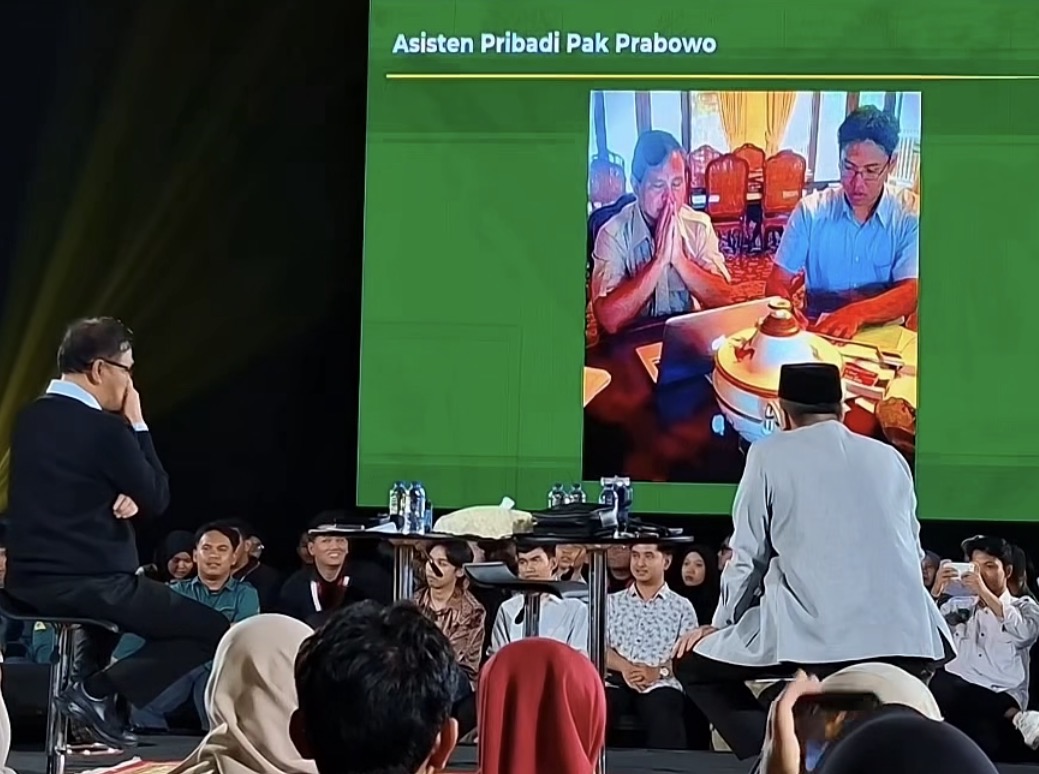
YOGYAKARTA, Jakartaweekly.com — The Gadjah Mada Student Movement said the disruption of a public discussion at UGM’s Innovation and Creativity Center (GIK) reflected growing student distrust toward the government.
Gladwin Panjaitan, spokesperson for the Gadjah Mada Student Movement, said the discussion, held on the evening of June 15, 2026, had effectively become a platform for showcasing the government’s achievements.
“The unequal allocation of speaking time prevented a meaningful and substantive exchange of ideas,” he said on Wednesday, June 17.
He stressed that students at Gadjah Mada University were not opposed to dialogue or discussion. However, he argued that such forums should be substantive, solution-oriented, and conducted on equal footing.
Gladwin also expressed regret that public attention surrounding the viral video had focused primarily on the shouting, unrest, and objects thrown toward the stage.
According to him, the public should instead focus on the students’ disappointment and growing distrust of the government, which he said formed the backdrop to the protest.
During the demonstration, students raised several issues, including the Free Nutritious Meals (MBG) program, which they argued came at the expense of education funding; the food estate project, which they said facilitated the displacement of Indigenous communities in Papua; and amendments to the Indonesian Military (TNI) and National Police laws, which they believe expand state influence into civilian spaces.
Economic, Political, and Governance Concerns
Gladwin said the protest did not emerge without cause, citing a range of economic, political, and governance issues as its driving factors.
“Our anger at GIK was triggered by many factors. In the economic sector, the rupiah briefly weakened to Rp18,000 per U.S. dollar earlier this month. The pressure stems from increasingly loose fiscal discipline and large-scale prestige projects that offer limited benefits,” he said.
He added that students were also concerned about the state budget deficit, which they said had reached Rp180.4 trillion. In their view, narrowing fiscal space could constrain spending on education, healthcare, and social protection programs—sectors they believe have already faced budget cuts.
Another issue, he said, was the increase in Pertamax fuel prices, which could encourage consumers to switch to subsidized Pertalite fuel, potentially raising the government’s energy subsidy burden and placing further strain on public finances.
Students also highlighted concerns over layoffs, claiming that 88,519 workers lost their jobs in 2025, an increase of 13.5 percent compared with the previous year.
At the same time, they argued that spending on security institutions remained substantial. Gladwin noted that the Defense Ministry received an allocation of Rp185 trillion, while the National Police, the State Intelligence Agency (BIN), and the National Narcotics Agency (BNN) collectively received Rp179.4 trillion.
“Meanwhile, militarization continues to quietly enter public life through plans to establish reserve-component battalions in every regency and municipality. This is a systematic effort to dominate and monitor society,” he said.
He added that students were demanding accountability from Minister Nusron Wahid over allegations that Indigenous Papuan communities had been displaced in connection with National Strategic Projects (PSN). They also called for greater transparency regarding reports of security force violence in Papua.
The protesters further raised concerns about democracy and freedom of expression, pointing to an acid attack allegedly carried out by military personnel against human rights activist and KontraS deputy coordinator Andrie Yunus.
Protest Escalates During Discussion
Based on observations by Jakarta Weekly, tensions began to rise when Budiman Sudjatmiko mentioned the name of former UGM Student Executive Board (BEM) chairman Tiyo Ardianto, who had previously attracted public attention. The remark prompted reactions from several students attending the forum.
Shortly afterward, a number of students climbed onto the stage, interrupted the discussion, delivered speeches, and unfurled posters criticizing the government.
The situation became increasingly heated as protesters, event organizers, and security personnel engaged in verbal confrontations.
As tensions escalated, security officers and organizers evacuated Budiman Sudjatmiko, Nusron Wahid, and Sudaryono from the venue. Demonstrators then followed the three speakers to the parking area and briefly blocked vehicles attempting to leave.
Nusron Wahid and Sudaryono eventually stepped out of their vehicles and met with students near UGM’s South Gate. The two officials remained at the location as students continued to pose questions and demand explanations regarding a range of government policies, from issues in Papua to the state of democracy in Indonesia.
The dialogue proved challenging, however, with many protesters saying the officials’ responses were unsatisfactory.
After the discussion ended, Nusron and Sudaryono again attempted to leave campus. Demonstrators once more blocked the convoy, leading to pushing and shoving between protesters and security personnel. The two officials ultimately departed under tight security, while the situation gradually returned to normal later that evening.
Budiman Sudjatmiko’s Response
Budiman Sudjatmiko adopted a more conciliatory tone and did not directly condemn the student protest. Instead, he expressed regret that the discussion had not proceeded as planned.
“I deeply regret that such a valuable forum failed to take place,” Budiman said on June 16.
According to him, the discussion had the potential to develop into a healthier and more open exchange of ideas. He said he was willing to continue the dialogue during the incident, but the situation became increasingly difficult to control.
He stated that he had no objection to remaining inside the building and continuing the discussion if conditions had permitted.
“We are ready to listen, and we are ready to explain, regardless of political differences, as long as the discussion forum can be maintained,” he told reporters.
Budiman also said he had reported the incident to Cabinet Secretary Teddy Indra Wijaya. Going forward, he plans to continue explaining President Prabowo Subianto’s programs through discussions and public forums.
Budiman’s Reform-Era Background
Budiman Sudjatmiko is widely known as a Reformasi-era activist. During Indonesia’s 1998 pro-democracy movement, he was among the student activists who opposed the New Order government of President Soeharto.
At the time, Budiman served as chairman of the People’s Democratic Party (PRD), a political party he helped establish.
In 1998, he was sentenced to prison after being accused of masterminding the July 27 Incident. He later received amnesty from President Abdurrahman Wahid (Gus Dur) in 1999.
Budiman subsequently joined the Indonesian Democratic Party of Struggle (PDI-P) and served as a member of the House of Representatives for two terms, from 2009 to 2019.
In 2026, he serves as head of the National Agency for the Acceleration of Poverty Alleviation under President Prabowo Subianto’s administration.
Discover more