Purbaya vs Pramono: Controversy Over Jakarta’s Regional Bond Issuance
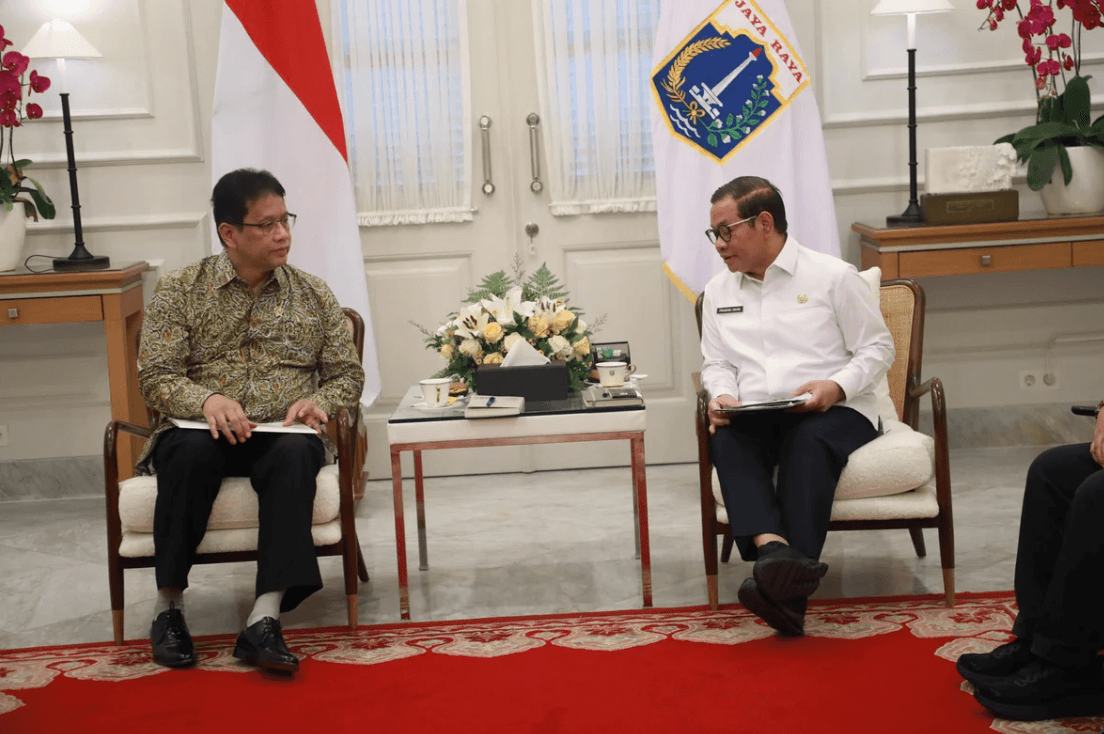
JAKARTA, Jakartaweekly.com – The Jakarta Provincial Government’s plan to issue Rp5.62 trillion worth of regional bonds in 2027 has sparked differing views with the central government.
Jakarta Governor Pramono Anung sees the bonds as a source of financing to support the capital’s development, while Finance Minister Purbaya Yudhi Sadewa believes Jakarta does not currently need to take on additional debt.
The Jakarta Provincial Government plans to issue the bonds starting in June 2027, with a maximum maturity of seven years. The proceeds will be used to finance several projects, including the construction of the LRT Phase 1C from Manggarai to Dukuh Atas, regional public hospitals (RSUDs), new school units, flood-control retention ponds, and public housing.
The plan has been included in the General Policy on Regional Budget (KUA) and Temporary Budget Priorities and Ceiling (PPAS) for the 2027 Regional Budget (APBD).
For the Jakarta Provincial Government, issuing regional bonds is one of the financing options available to meet the capital’s development needs. The Finance Ministry, however, believes additional borrowing should be carefully assessed based on the region’s fiscal capacity and the use of funds already available.
Purbaya believes Jakarta still has sufficient fiscal space and therefore does not need to seek financing through regional bonds. He has called on regional governments to optimize the funds they already have before taking on additional debt.
On September 8, 2026, Purbaya said around Rp100 trillion in regional government funds remained parked in banks at the end of each year. He said the situation indicated that substantial liquidity was still available and could be put to more productive use.
Purbaya has also warned regional governments to take into account the long-term risks associated with issuing bonds. He pointed to experiences in several Latin American countries, where problems arose after regional governments failed to meet their debt obligations, ultimately leaving central governments to shoulder the risks.
For that reason, Purbaya has suggested that Jakarta use financing through PT Sarana Multi Infrastruktur (SMI) to meet its infrastructure development needs.
The Jakarta Provincial Government, however, continues to view its development financing needs as a reason to proceed with the bond plan.
Pramono said the central government had indeed urged regional governments to exercise caution when issuing debt securities. However, Jakarta would still submit its bond proposal because the provincial government has a number of development projects to undertake.
According to Pramono, Jakarta’s relatively large financial resources cannot be viewed separately from the extensive development responsibilities the capital has to fulfill.
“Mr. Purbaya said Jakarta has a lot of money. But we have also been asked to build a lot. And building requires money,” Pramono said.
Pramono also offered an alternative if the central government does not want Jakarta to seek financing through regional bonds. He called on the central government to restore the Revenue Sharing Fund (DBH) allocated to Jakarta to its previous level.
“If not, then please restore the revenue-sharing funds,” Pramono said.
Ultimately, the issue is not simply whether regional governments are legally allowed to issue bonds. Purbaya acknowledged that regional governments have the authority to issue debt securities as long as they adhere to the principle of prudence. His concern, however, is that Jakarta is not currently in a position where additional borrowing is necessary.
Financing the Future Wisely
The debate has also drawn a different perspective from Yustinus Prastowo, Deputy Coordinator of the Jakarta Governor’s Special Staff.
In a post on his X account, Prastowo wrote, “Pramono or Purbaya? Why not both!” He argued that the differing views should not necessarily be framed as a choice between fiscal discipline and development.
“It is about how we finance the future wisely,” Prastowo wrote.
He said the fiscal prudence emphasized by the Finance Minister remains important. At the same time, Jakarta needs to seek new sources of financing to develop public transportation, hospitals, schools, housing, flood-control infrastructure, and other facilities whose benefits can extend across generations.
According to Prastowo, debt should not automatically be viewed as a problem as long as it is used productively, properly assessed, managed transparently, and supported by sustainable debt-servicing capacity.
What should be avoided, he said, is using debt to cover fiscal weaknesses or finance routine expenditure.
Under this approach, Prastowo argued that regional bonds could serve as an investment instrument for future development, provided they are backed by strict debt limits, careful project selection, sound governance, and transparency.
Jakarta’s Fiscal Space
The debate over Jakarta’s regional bonds comes as the capital’s budget structure is also undergoing changes.
Jakarta’s 2026 Regional Budget (APBD) was set at Rp81.32 trillion, down from Rp91.86 trillion in 2025. The decline was mainly driven by a reduction in transfers from the central government through the Transfer to Regions (TKD) scheme, which fell from Rp26.14 trillion to Rp11.16 trillion.
Under the 2026 APBD, Jakarta’s Regional Original Revenue (PAD) was targeted at Rp57.67 trillion, while regional financing receipts were set at Rp9.87 trillion.
Regional expenditure was budgeted at Rp74.28 trillion, with financing expenditure set at Rp7.04 trillion.
The Jakarta Provincial Government subsequently submitted a draft 2026 Revised Regional Budget (RAPBD-P). Under the proposal, regional revenue is projected to decline to Rp69.36 trillion, comprising Rp57.87 trillion in PAD and Rp11.28 trillion in transfers from the central government.
Regional expenditure, meanwhile, is projected to rise to Rp75.08 trillion. As a result, Jakarta’s total APBD would fall to Rp79.59 trillion from Rp81.32 trillion previously.
As of September 8, 2026, Jakarta’s realized regional revenue had reached Rp41.48 trillion, equivalent to 58.06% of the budget target. Meanwhile, realized regional expenditure stood at Rp37.12 trillion, or 49.98% of the budget ceiling.
BondDKI JakartaIndonesiaJakarta BondJakarta' regional budgetPramono AnungPurbaya Yudhi SadewaYustinus Prastowo
Discover more