Expert Says Prabowo’s 2027 Economic Growth Target is Too Optimistic
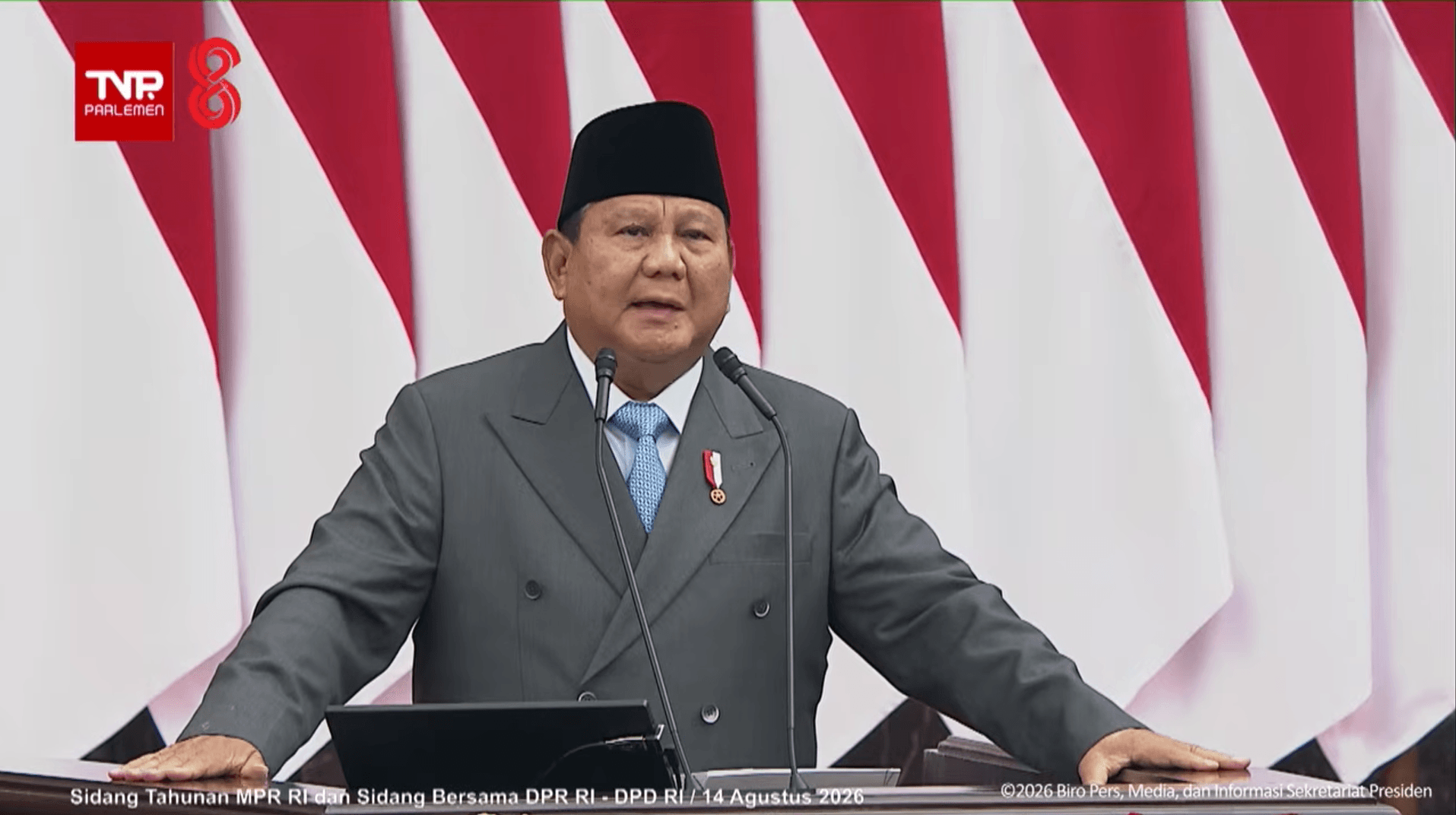
JAKARTA, Jakartaweekly.com—CELIOS Digital Economy Director Nailul Huda said the 2027 economic growth target in the 2027 Draft State Budget (RAPBN 2027), presented by President Prabowo Subianto last Friday, was overly optimistic, particularly as the government is targeting Indonesia’s economic growth to reach 6% in 2027.
“I consider the 6% economic growth target too optimistic amid current global and domestic economic conditions,” Nailul Huda told Jakarta Weekly.
Nailul explained that the global economy is currently facing significant shocks as escalating geopolitical tensions are expected to increase global uncertainty. The World Bank projects global economic growth at only 2.8%, while the OECD forecasts 3.1% and the IMF 3.4%.
The global growth outlook is in line with slowing economic growth in other major economies, including China and the United States. This is compounded by movements in central bank benchmark interest rates, with countries such as the US and Japan already entering a positive interest-rate regime. Meanwhile, escalating conflicts in the Middle East could weigh on global trade.
Domestically, concerns include the potential impact of “Godzilla El Niño,” inflation and a weakening rupiah, all of which could reduce household purchasing power. There are also risks from rising global oil prices, which could push up Indonesia’s Indonesian Crude Price (ICP), put further pressure on the state budget and disrupt global supply chains.
“This could put pressure on household consumption, which has historically contributed more than 50% of national GDP. The looming threat of mass layoffs will also remain a factor weighing on economic growth in 2027,” Nailul said.
He also argued that government spending, which has served as one of the key drivers of economic growth, has already been heavily utilized during 2025-2026. As a result, there may be no significant fiscal lever left to drive economic growth in 2027.
“Economic growth in 2027 will likely be capped at 4.7% under various conditions, including rising layoffs in 2026 and inflation expected to increase due to higher production costs, which could put further pressure on household consumption,” Nailul said.
On government spending, state expenditure is expected to come under pressure as the government normalizes the Free Nutritious Meals (MBG) program, accompanied by significant budget cuts. In addition, development under the KDKMP program is no longer expected to provide a boost to the construction sector.
As a result, the remaining fiscal capacity of village governments to utilize Village Funds will be reduced as they need to allocate funds toward KDKMP debt repayments to state-owned banks. Consequently, the growth multiplier effect from rural areas is expected to be significantly weakened in 2027.
The government’s 2.5% inflation target is also considered unrealistic, as it does not adequately take into account potential increases in food prices. Nailul said the government had not sufficiently accounted for the impact of “Godzilla El Niño” and imported inflation.
Nailul even projects inflation to reach 5.74% in 2027, driven by rising food prices nationwide, including rice and other key commodities. The increase in food prices is expected to be triggered by “Godzilla El Niño,” which is projected to occur from late 2026 through early 2027.
On the rupiah exchange rate, Nailul said the government’s assumption of Rp17,500 per US dollar was also too optimistic, given that the currency is currently trading in the Rp17,800-Rp18,100 per US dollar range.
“So it can be said that there is little possibility of the rupiah returning to Rp17,500 per US dollar. Our projection is Rp18,400 per US dollar, which is weaker than the current level,” he said.
The weakening rupiah is being driven by low investor confidence, with capital outflows continuing if fiscal management is not prudent. Domestically, confidence is also being undermined by the high level of rupiah-to-foreign-currency conversions, particularly into US dollars.
Nailul also projects the yield on 10-year Indonesian government bonds (SBN) to reach 7.5%, given that it currently stands at around 7.26%. The 10-year SBN yield could rise even further if fiscal management remains reckless and further erodes investor confidence.
Meanwhile, the Indonesian Crude Price (ICP) is projected to average US$97 per barrel in 2027. Global oil prices are expected to remain elevated at US$95-US$120 per barrel in 2027 as geopolitical tensions in the Middle East show no signs of easing.
For 2027, the government is targeting tax and customs revenue of Rp2,908 trillion, with tax revenue projected to grow by as much as 10.5%.
“I believe this target is highly ambitious, considering that there appears to be a shortfall this year,” he said.
This means next year’s target could once again fall short. One factor to watch is tax refunds at the end of 2026 and early 2027, which could reduce tax revenue collected next year.
Nailul estimates total tax and customs revenue at only Rp2,736 trillion, assuming economic growth of 4.7% and inflation of around 5.74%. This would be equivalent to 9.39% of national GDP.
Meanwhile, non-tax state revenue (PNBP) is projected at only Rp447 trillion, reflecting declining revenues from natural resources, with natural resource exports expected to slow due to PT DSI.
Government spending is targeted at Rp4,097 trillion, which Nailul described as very high, with a significant imbalance between central and regional government spending. He said regional governments were once again not receiving the funding they should.
Although the allocation is higher than in 2026, it remains below the 2025 level, representing a setback in efforts to increase development capacity in the regions.
Meanwhile, actual government spending is projected at only Rp3,766 trillion due to adjustments to state expenditure for the MBG program and budget adjustments for several other programs. State expenditure would be equivalent to 13% of national GDP.
“Transfers to the regions should be around Rp957 trillion to meet development needs in the regions. With that allocation, the state budget deficit is projected at Rp582 trillion, equivalent to 2% of national GDP,” he concluded.
Discover more