Laut Bercerita Review: Young Activists Confront the Threat of State Power
JAKARTA, JakartaWeekly.com — Reza Rahadian, Eva Celia, Christine Hakim, Dian Sastrowardoyo, and Arswendy Bening Swara are among the acclaimed actors starring in Laut Bercerita. Their involvement raised my expectations, and perhaps those of other Indonesian filmgoers, for this production by Pal8 Pictures.
And for good reason. The cast’s acting abilities are well established, with numerous accolades to their names. The experience and calibre of the veteran performers involved also promised a film worth looking forward to.
Those expectations were largely met when I watched Laut Bercerita at a press screening in Jakarta on Tuesday, October 20, 2026. The cast brings their respective characters to life, conveying emotions through facial expressions and gestures rather than relying solely on dialogue.
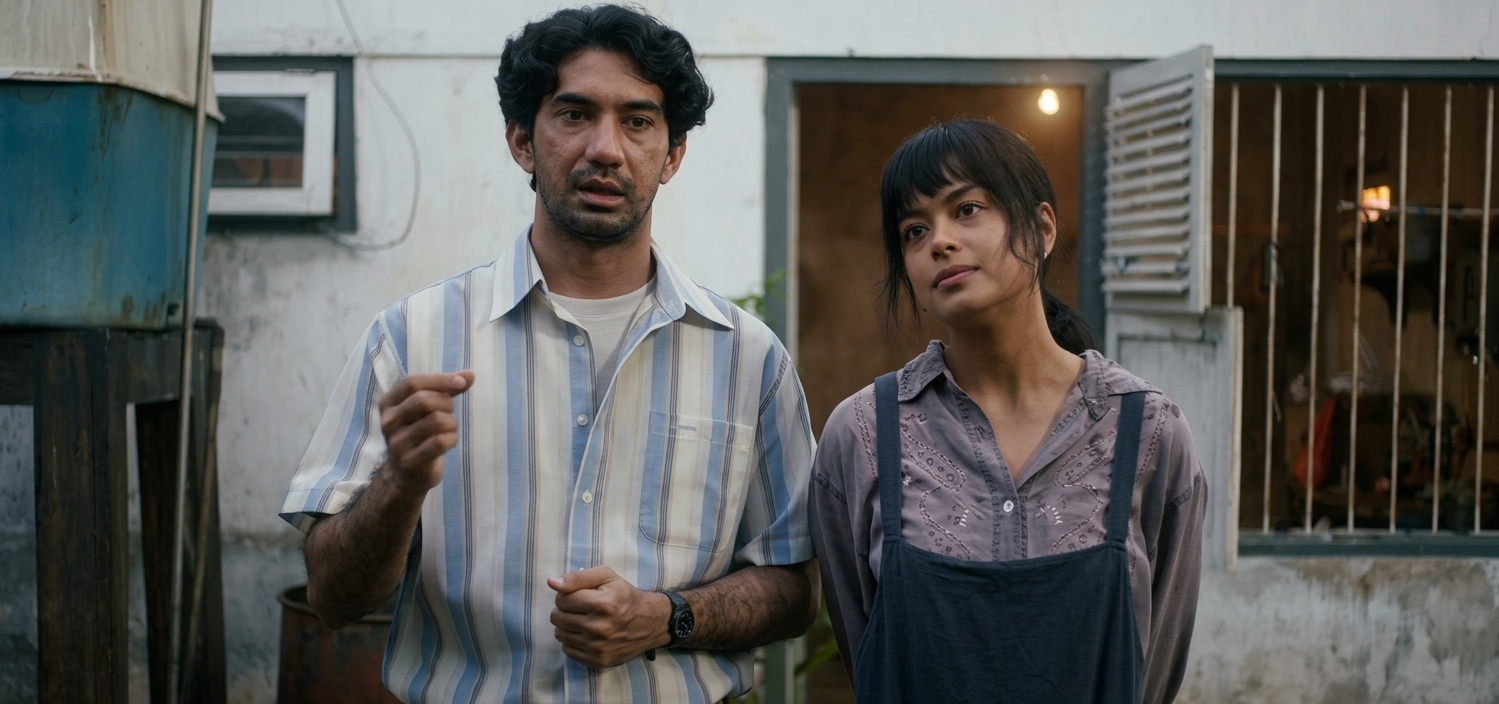
Reza Rahadian, who plays the central character, Biru Laut, is one of the film’s greatest strengths. He portrays Laut not merely as an activist, but also as a son, an older brother, a friend, and a lover. These different facets emerge through Laut’s behaviour and interactions with the people closest to him.
As a son, Laut displays a natural, almost boyish side. His interactions with his parents, particularly his mother, feel genuine, whether they are talking around the dining table or in the kitchen. His gaze, gestures, and responses to his parents make their family relationship feel intimate and unforced.
A similar warmth emerges in his interactions with his younger sibling. Casual jokes over the phone and conversations at home reveal a more relaxed side of Laut. Despite his idealism and commitment as an activist, he remains an older brother with a deep emotional connection to his family.
Among his fellow activists, Laut reveals a different side of himself. Reza convincingly portrays an activist who is principled, firm, courageous, and critical. His conduct during discussions and organisational activities reflects the convictions that underpin his struggle.
With his romantic partner, meanwhile, Laut reveals a more personal side. There is a tenderness and emotional intimacy that differ from the persona he adopts in the midst of his activism. These contrasts make Laut feel like a fully realised character, someone whose life is shaped not only by idealism but also by love and relationships with those closest to him.
Reza’s ability to convey these different facets is one of his greatest strengths as a performer. He does not simply play an activist; he portrays a human being with multiple roles in life. The shifts in his demeanour and interactions with family, friends, and his lover add depth to Biru Laut’s character.
The strong performances are not limited to the lead actor. The rest of the cast also conveys fear, grief, and love without needing to say much. Their facial expressions and body language are often enough to make the characters’ emotions resonate with the audience.
Arswendy Bening Swara’s portrayal of Laut’s father, for instance, conveys his concern for his son’s safety. Yet beneath that anxiety, he tries to remain strong. He must hold back his feelings as he confronts an increasingly difficult situation.
The mother is portrayed in much the same way. Her grief is not expressed through excessive sobbing. Instead, her tears and anxious gaze convey the profound anguish of facing the possibility of losing a beloved child.
This restrained approach to acting is one of the reasons the relationships between characters feel convincing. Emotions are not always spelt out explicitly; they emerge through interactions and the small details brought to life by the cast.
Cinematography That Brings the 1990s to Life
The cast’s performances are complemented by visuals that transport audiences back to the 1990s. Communication devices such as pagers, retro-style photographs, clothing, vehicles, and household objects all help establish an atmosphere consistent with the period in which the story takes place.
From a cinematographic perspective, Laut Bercerita offers an engaging visual approach through its use of varying shot sizes, camera angles, lighting, and composition. In the dining-room scene, for example, a static wide shot captures the entire room and the positions of the characters within it.
The camera does more than record a family interaction. It gives the audience room to observe the atmosphere and the distance between family members. This approach makes the domestic scene feel natural while allowing emotional tension to emerge without always having to be articulated through dialogue.
When the story shifts to interactions between individual characters, medium close-ups and close-ups draw attention to their facial expressions. Over-the-shoulder (OTS) shots during conversations also create the impression that viewers are right there in the middle of the exchange.
The use of shallow depth of field, with the background blurred while the characters remain in focus, further emphasises the actors’ expressions and body language. Details such as eye movements and subtle changes in facial expression are given room to convey emotion.
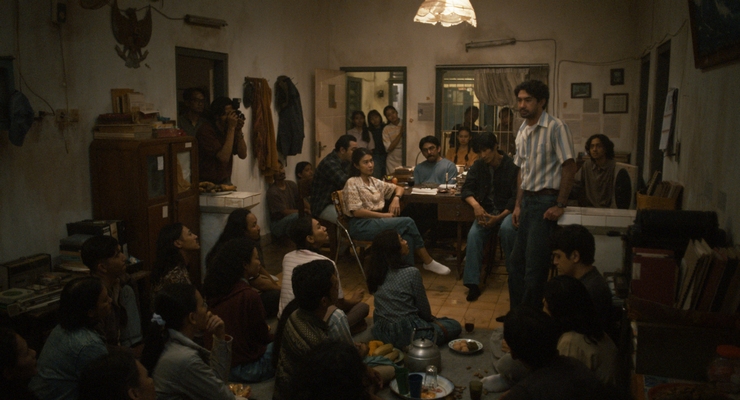
The visual approach changes when the film depicts Laut’s life among his fellow activists. Wide shots in discussion rooms capture several characters at once, along with supporting elements such as information boards. These compositions establish the spaces in which the group operates while reinforcing the idea that Laut’s struggle takes place within a collective movement rather than as an individual undertaking.
Meanwhile, motorcycle scenes featuring motion blur in the background create a sense of movement and dynamism. This visual contrast helps distinguish the rhythms of everyday life from the film’s more serious moments.
The use of high-angle shots in scenes depicting crowds of demonstrators is also striking. From this perspective, people gathered between buildings appear within a single composition that conveys both the density of the crowd and the limitations of their physical space.
The camera does more than show the number of people involved; it also creates a sense of pressure and confinement. In another visual choice, shots filmed through iron bars use them as foreground framing, allowing the characters’ faces to be seen through the metal boundaries.
This composition reinforces the feeling of confinement and makes the characters’ circumstances more unsettling. Visual elements do not merely accompany the narrative; they actively shape the atmosphere experienced by the audience.
Colour and lighting also contribute significantly to the film’s visual appeal. The dominance of brown, cream, yellowish green, and other earthy tones creates a retro aesthetic that complements the story’s historical setting.
This effect is supported by natural light streaming through windows and doorways, lending an organic quality to many of the indoor scenes. Elsewhere, relatively dim lighting and deep shadows create a more sombre atmosphere.
The interplay between warm colours and shadows prevents the film’s visual palette from becoming monotonous, allowing it to adapt to the mood of each scene.
The production design also deserves recognition. Wooden furniture, tableware, communication devices, clothing, vehicles, and information boards help recreate an environment appropriate to the period. These elements do not function merely as decoration; they are integrated into the cinematography and lighting.
As a result, the film’s historical setting comes to life through details that audiences can observe without having to be told about them through dialogue.
For me, the strength of Laut Bercerita‘s cinematography lies in the contrast between its visual treatment of personal spaces and spaces associated with the struggle. Family scenes allow for more intimate expressions and interactions, while demonstrations and scenes of detention employ compositions that emphasise crowded spaces, restricted movement, and the pressure faced by the characters.
The camera does not simply document the story’s events; it also shapes how audiences experience shifts in atmosphere. The interplay of shot sizes, camera angles, lighting, and production design is central to bringing Biru Laut’s world to life.
A Nonlinear Narrative and Tension That Never Quite Peaks
Despite its strong performances and striking visuals, Laut Bercerita has several aspects that, in my view, warrant criticism, particularly in its dramatic development and the way it builds tension.
The film opens with a flashback before moving forward through the characters’ journeys. In the opening sequence, Laut is shown inside a safe house before being taken away by several imposing men.
Before that scene, the film opens with the sound of a radio switching between stations. The familiar sound of changing frequencies establishes a distinctive atmosphere while preparing audiences for a story marked by uncertainty.
Both sequences effectively create tension and arouse curiosity about Laut, who is identified by Amir Zein as Winatra’s secretary-general.
The narrative then moves back to a time before Laut becomes involved in the movement. Audiences are introduced to him as someone who enjoys writing, thinks critically, and reads books. The film subsequently shows how he becomes involved in a movement emerging from the university environment.
The story continues with his interactions with fellow activists in an organisation called Winatra. Viewers are shown how they discuss ideas, organise their movement, and take action. Amid this life of activism, the film also weaves in Laut’s personal life, including his romantic relationship.
The film’s message is relatively easy to grasp. Audiences do not have to work particularly hard to understand the conflicts presented, as the story unfolds through relationships between characters, dialogue, and interconnected events.
Yet a story’s accessibility does not necessarily translate into emotional impact. In several places, I felt the dramatic development failed to draw audiences deeply enough into the situations experienced by the characters.
In terms of pacing, Laut Bercerita reminds me of Istirahatlah Kata-Kata (Solo, Solitude), a film about the life of poet and activist Wiji Thukul, who also disappeared during the New Order era. Directed by Yosep Anggi Noen, the film shares a relatively slow pace with Laut Bercerita, allowing space for atmosphere and the characters’ personal experiences.
A slow pace is not inherently a problem. This approach can give audiences time to understand a character’s inner world and absorb the circumstances they face. However, in my view, a measured tempo needs to be accompanied by discernible emotional progression, particularly when the story reaches moments that should carry greater dramatic weight.
One area that feels underdeveloped is the drama surrounding the activists’ flight from authorities. The film depicts several situations that convey the pressure they face, including a visit from people searching for Laut at his parents’ home. Yet these sequences feel somewhat flat and do not fully build the tension they could have generated.
I would have liked to see more intense interactions among the activists on the run. Their predicament offers considerable dramatic potential for a wider range of emotional responses: fear, anxiety, conflict among comrades, exhaustion, and attempts to preserve hope amid uncertainty.
That potential is already present in the story. However, the film conveys much of this experience through Laut’s account. As a result, some experiences that could have been made immediate and palpable for the audience instead feel like information being recounted after the fact.
A few humorous exchanges are inserted amid the more serious situations. These moments could have revealed the activists’ humanity under pressure. Unfortunately, they feel more like brief interludes than substantial interactions capable of deepening the relationships between characters.
Laut’s romantic storyline also feels underdeveloped. The film introduces the protagonist’s personal side, but the relationship does not receive enough development to create a deeper emotional impact on the narrative as a whole.
Consequently, the tension that should build towards the events that set the opening sequence in motion never quite reaches its full potential. A similar issue arises when the film moves into the activists’ arrest.
I would have liked the film to devote more time to the activists’ psychological states after their arrest. Their struggle with uncertainty, fear, loneliness, and longing for family and friends could have added considerable emotional depth to the story.
The film could have explored how someone tries to maintain their sanity under the psychological strain of detention, perhaps through inner dialogue or changes in behaviour that reflect the character’s development. Such an approach could have shown the human toll of detention rather than treating the arrests merely as a series of plot events.
Of course, this would not have required reducing the emphasis on the families and friends searching for the missing activists. On the contrary, these two perspectives could have complemented each other: the experiences of those in detention and the anguish of those who continue searching for them outside.
These criticisms do not mean that Laut Bercerita lacks merit. The film still offers convincing performances, a carefully crafted visual approach, and a portrayal of activist life intertwined with family relationships and personal struggles. However, in my view, several parts of the story do not fully realise their emotional potential.
A Film That Makes Me Want to Read the Novel
Some time ago, while visiting a book fair at Taman Ismail Marzuki, I came across Laut Bercerita, the novel by Leila S. Chudori. At the time, I resisted the urge to buy it because I wanted to experience the film first, without having my expectations shaped by the novel’s version of the story.
After watching the film, my desire to read the novel has only grown stronger. I want to discover how the story unfolds on the page, how the characters’ experiences are developed, and which aspects might be explored in greater depth in the book.
Ultimately, Laut Bercerita leaves a strong impression through its performances and visual storytelling, even though parts of its dramatic development lack the emotional bite they could have had. The film brings Biru Laut to life as a person shaped by both personal relationships and idealism, but it does not fully translate the story’s emotional potential to the screen.
Perhaps, after all, it is time for me to buy and read Laut Bercerita.
Discover more