Bank Indonesia Holds BI Rate at 5.75%
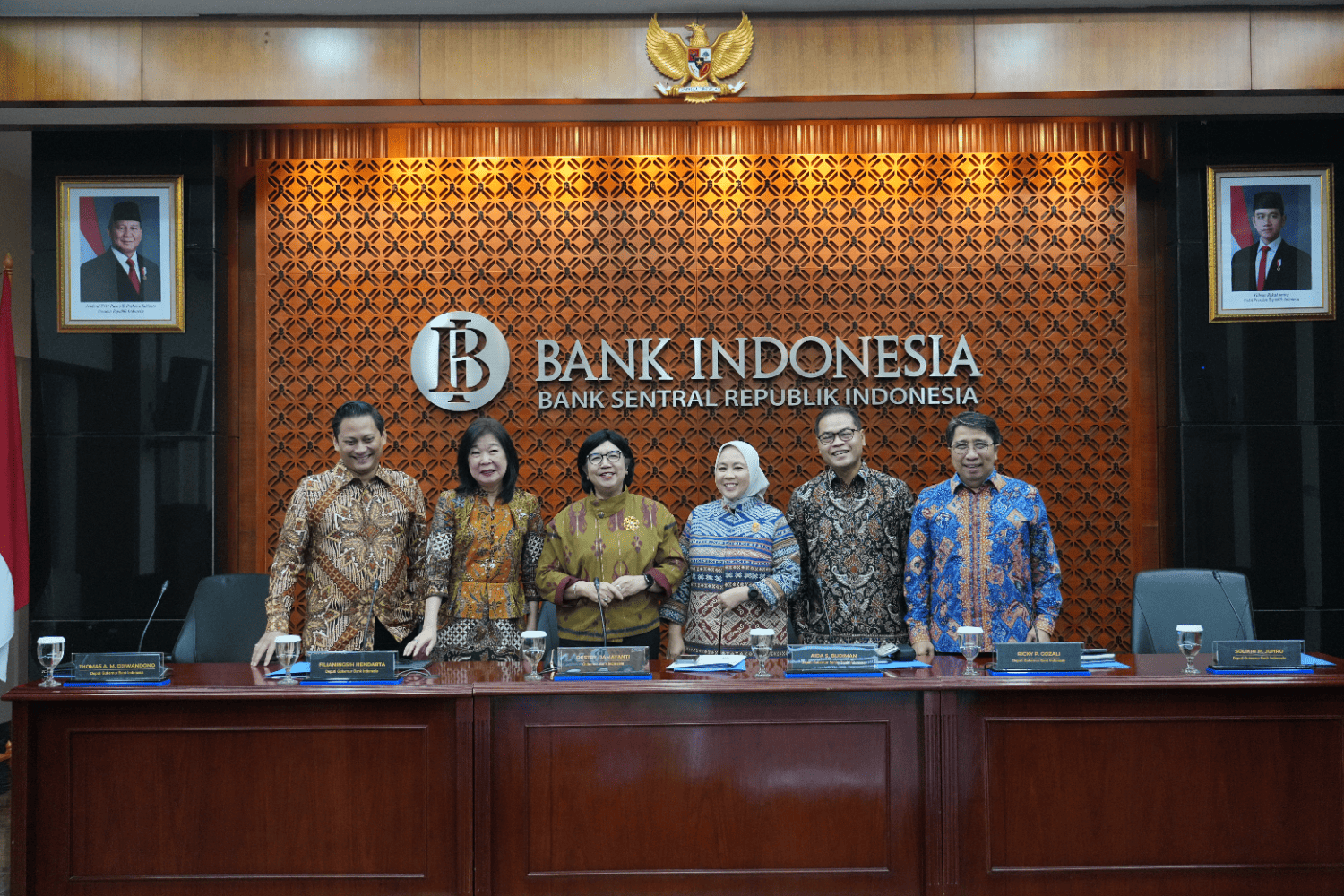
JAKARTA, JakartaWeekly.com—Bank Indonesia (BI) has decided to keep its benchmark BI Rate unchanged at 5.75%. At its Board of Governors Meeting (RDG BI) held on October 20–21, 2026, BI also decided to maintain the lending facility rate at 6.5%, while raising the deposit facility rate to 5%.
Bank Indonesia Governor Destry Damayanti explained that the decision was made as part of the central bank’s strategy to stabilize the rupiah amid persistent external pressures. It also forms part of efforts to keep inflation within the target range of 2.5% in 2026 and 2027.
The decision was accompanied by enhanced incentives for hedging instruments under the Domestic Non-Deliverable Forward (DNDF) scheme with Bank Indonesia. The measures aim to attract foreign capital inflows, maintain rupiah exchange rate stability, and accelerate the deepening of the money and foreign exchange markets.
“Going forward, Bank Indonesia will continue to optimize various monetary policy instruments to strengthen external resilience, including taking necessary adjustment measures to consistently maintain economic stability,” Destry said on Wednesday, October 21, 2026.
BI considers the outlook for the global economy to remain weak, while financial market uncertainty remains elevated. These conditions have been influenced by escalating tensions in the Middle East, which have kept global oil and commodity prices high.
Global economic growth in 2026 is projected to remain weak at around 3.0%, while inflationary pressures are expected to stay elevated at approximately 4.6%. Tight global monetary policy is expected to persist for an extended period, a scenario known as “higher for longer.” This includes a significant possibility of another increase in the United States (US) Federal Reserve’s policy rate, the federal funds rate (FFR).
US Treasury yields also remain high, reflecting stronger expectations regarding the future direction of US monetary policy and the country’s substantial government budget deficit. In global financial markets, investor appetite for portfolio assets in emerging markets remains limited, keeping the US dollar strong against both developed and emerging market currencies, as reflected in the US Dollar Index (DXY).
These conditions underscore the need for a stronger response and closer coordination between fiscal and monetary policies to bolster external resilience, maintain stability, and support domestic economic growth.
Meanwhile, BI considers Indonesia’s economic growth to remain resilient and says it needs to be further supported by strengthening various sources of growth.
Recent developments indicate that household consumption has remained stable, supported by the continuation of various government fiscal stimulus measures and improving consumer expectations.
Investment performance has also remained positive, driven primarily by government investment and the growing contribution of private investment, in line with improving producer confidence reflected in an expansionary manufacturing Purchasing Managers’ Index (PMI).
On the external front, non-oil and gas exports have increased, although further efforts are needed to capitalize on rising export commodity prices. Going forward, Indonesia’s economic growth is projected to remain solid, supported by continued government stimulus, improving business confidence, and stronger contributions from various sources of economic growth.
Bank Indonesia projects Indonesia’s economic growth in 2026 to range between 4.9% and 5.7%.
Destry explained that Indonesia’s balance of payments (BOP) needs to be further strengthened to improve external resilience amid persistently high global uncertainty.
Indonesia recorded a trade surplus of US$ 3.55 billion in August 2026. Meanwhile, foreign portfolio investment recorded net outflows of US$ 0.08 billion in the third quarter of 2026, mainly due to outflows from the stock market amid elevated global financial market uncertainty.
Stock market outflows continued in October 2026, while Bank Indonesia Rupiah Securities (SRBI) and Government Securities (SBN) recorded inflows. As a result, foreign portfolio investment recorded net inflows of US$ 0.66 billion in the fourth quarter of 2026 as of October 19, 2026.
Indonesia’s foreign exchange reserves stood at US$146.3 billion at the end of September 2026, equivalent to 5.3 months of imports, or 5.2 months of imports and government external debt servicing. This level remains above the international adequacy standard of approximately three months of imports.
“Going forward, external resilience is expected to remain strong, with the 2026 current account projected to record a deficit in the range of 2.4%-1.6% of GDP,” Destry said.
BI also noted that the rupiah’s depreciation had been influenced by escalating geopolitical tensions in the Middle East, tighter US monetary policy, and foreign investor sentiment in the stock market. In response, BI has introduced various incentives to attract foreign portfolio investment inflows.
Since the policy was introduced in June 2026, it has successfully attracted US$9.9 billion in foreign capital inflows as of October 20, 2026. Going forward, Bank Indonesia expects the rupiah exchange rate to remain stable, supported by the central bank’s commitment, attractive yields, inflation remaining within its target range, and a favorable domestic economic outlook.
BI considers Consumer Price Index (CPI) inflation to remain within its target range.CPI inflation stood at 3.28% year-on-year (yoy) in September 2026, up from 3.19% yoy in the previous month.
Inflation remained under control, supported by a decline in core inflation to 2.84% yoy, in line with Bank Indonesia’s consistent efforts to maintain price stability. Inflation in the administered prices (AP) component also eased to 3.25% yoy, mainly due to lower airfares.
Meanwhile, volatile food (VF) inflation rose to 5.03% yoy, driven by declining production in several key producing regions, primarily due to weather-related disruptions.
Bank IndonesiaBank Indonesia Governor Destry DamayantiBI Ratedeposit facility rateIndonesiaInterest ratelending facility rateRDG BI
Discover more