Rupiah Weakens Toward Rp17,000 as Oil Prices Surge
Jakartaweekly.com — The Indonesian rupiah weakened on Friday as the US dollar strengthened amid rising global oil prices and concerns over geopolitical tensions in the Middle East.
According to Ibrahim Assuaibi, Director of PT Traze Andalan Futures, the dollar’s strength was driven primarily by global risk sentiment linked to energy supply disruptions and inflation expectations.
Oil prices surge amid Iran tensions
Global oil prices climbed sharply after reports that Mojtaba Khamenei indicated the Strait of Hormuz would remain closed.
The narrow waterway is a crucial global energy chokepoint through which roughly one-fifth of the world’s oil and gas supply passes. Its closure has triggered what analysts describe as one of the largest supply disruptions in the history of the global oil market.
Market participants are increasingly concerned that the spike in energy prices could trigger a new wave of global inflation. Brent crude oil futures were last trading near US$100 per barrel.
Higher energy prices could complicate monetary policy for central banks. Analysts say the Federal Reserve may need to reconsider plans for near-term interest rate cuts if inflation pressures rise again.
Higher borrowing costs could also attract global capital into US assets, strengthening the dollar against emerging market currencies.
Investors are also closely monitoring US inflation data released this week. The US Consumer Price Index released on Wednesday showed inflation largely stable in February compared with the previous month.
However, the data did not yet reflect potential inflationary pressure from rising oil prices linked to the ongoing Iran–Israel conflict.
Markets are now awaiting the Personal Consumption Expenditures Price Index, scheduled for release later this week, which could provide further clues about the US inflation outlook and long-term interest rate expectations.
Domestic fiscal pressures remain in focus
Domestically, investors are also watching Indonesia’s fiscal dynamics, particularly the growing burden of government debt interest payments.
Estimates based on the state budget deficit and primary balance suggest that debt interest payments had reached Rp99.8 trillion as of February 2026. This amount represents around 27.8% of total state revenue, which stood at Rp358 trillion, and roughly 28.8% of central government spending, recorded at Rp346.1 trillion last month.
The risk of rising debt servicing costs may increase amid global geopolitical tensions and government debt management policies, including a debt switch arrangement between Bank Indonesia and the Indonesian government.
Higher global yields have also pushed up Indonesia’s sovereign bond yields. According to data from the Ministry of Finance of Indonesia, the yield on Indonesia’s 10-year government bonds (SBN) stood at 6.52% as of March 10, 2026, while the 10-year US Treasury yield was at 4.09%.
Since the beginning of the year, Indonesian bond yields have risen 55 basis points, a development that could increase the government’s future interest payment obligations.
Despite these pressures, the government remains optimistic about managing debt prudently through careful portfolio management and controlled annual issuance. Officials say the strategy aims to maintain sustainable levels for both the interest payment ratio and the Debt Service Ratio (DSR).
Stronger tax revenue growth may also help ease the burden. Tax receipts reportedly rose 30.4% year-on-year in February 2026, potentially improving the government’s debt servicing indicators.
Rupiah movement
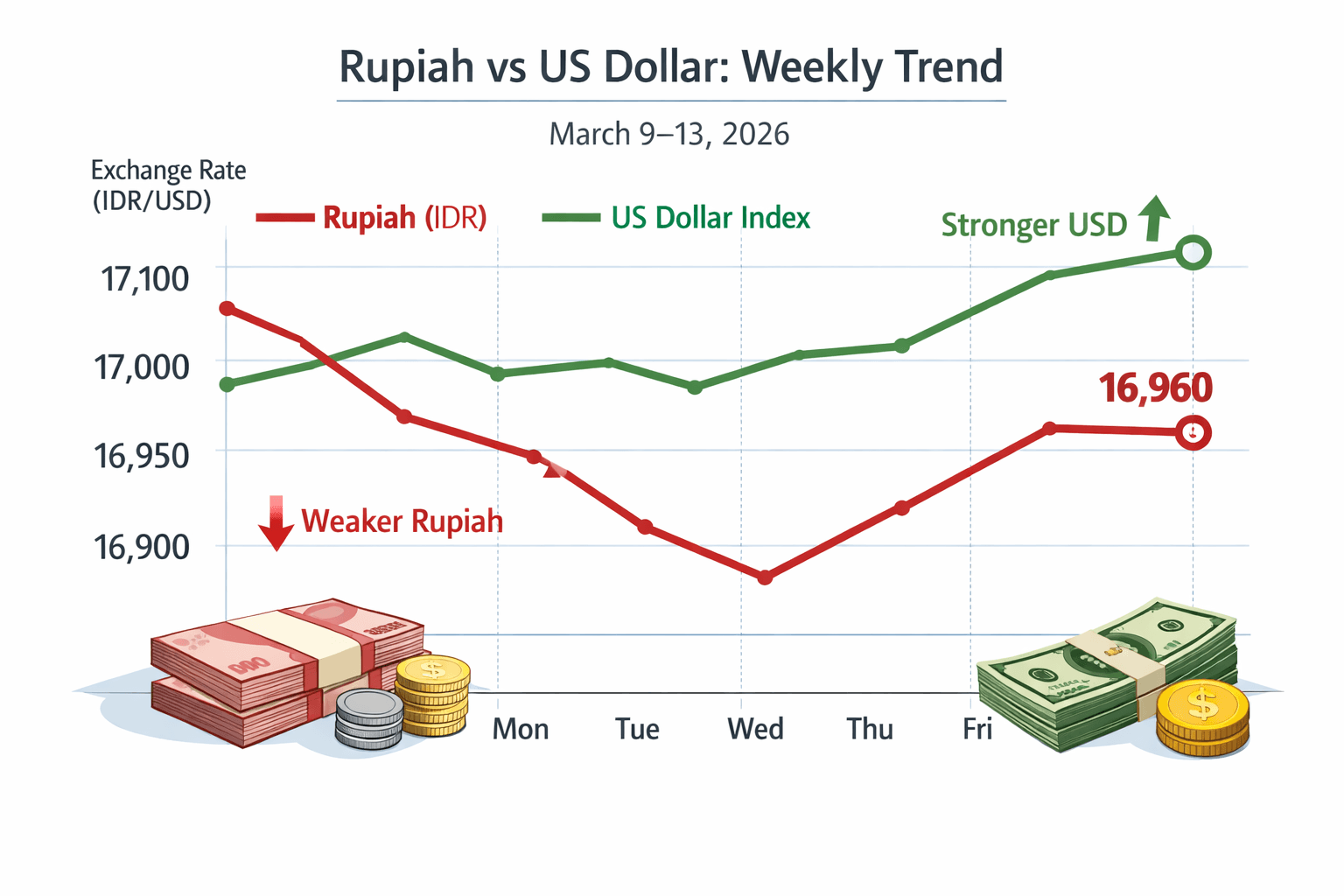
In Friday afternoon trading, the rupiah closed 67 points weaker at Rp16,960 per US dollar, after earlier weakening by as much as 70 points from the previous close of Rp16,893.
Assuaibi expects the rupiah to remain volatile but biased toward further weakening in the next trading session, with a projected range of Rp16,960 to Rp17,020 per US dollar.
For the coming week, the rupiah is forecast to trade within a broader range of Rp16,850 to Rp17,150 per US dollar.
Image source: ChatGpt
Discover more