
Three Scenarios for Jakarta Stock Market Amid Iran–US–Israel Conflict
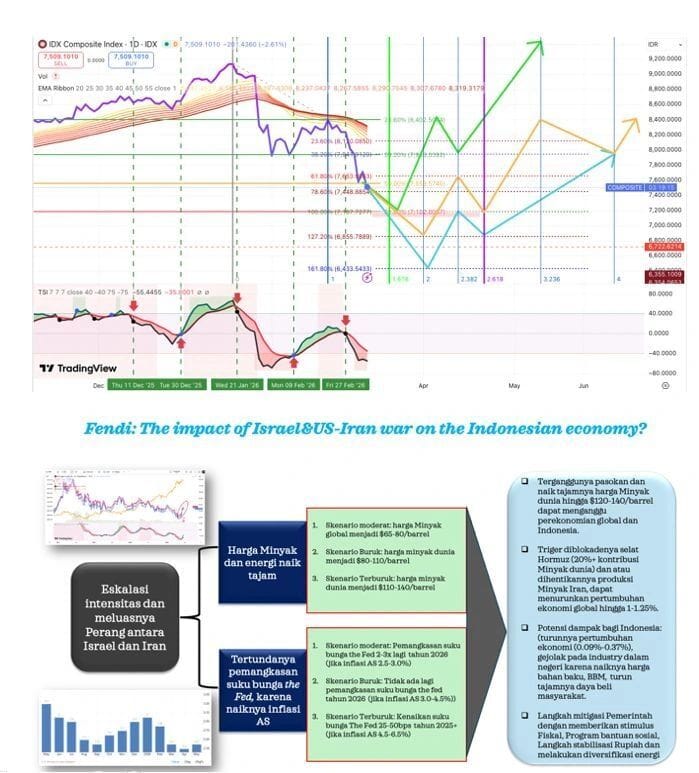
Jakartaweekly.com – The escalation of tensions involving Iran, Israel, and the United States has put pressure on Indonesia’s stock market since early March 2026, according to Fendi Susiyanto, Founder and CEO of Finvesol Consulting.
He noted that the Jakarta Composite Index (JCI) has declined sharply in recent days due to negative global sentiment triggered by the conflict.
“The escalation in strategic areas such as the Strait of Hormuz has pushed global oil prices higher, with Brent Crude Oil rising above US$80 per barrel. This adds pressure to emerging markets including Indonesia,” Fendi said.
According to him, the situation could create three possible scenarios for Indonesia’s stock market.
First, if the conflict escalates further, the JCI could remain under pressure as foreign investors shift funds to safe-haven assets such as gold. Large-cap and banking stocks are likely to face continued selling pressure.
Second, higher global energy prices could benefit Indonesia’s energy sector. While the broader market weakened, energy-related stocks have recently emerged as the main outperformers due to rising commodity prices.
Third, if geopolitical tensions ease, market sentiment could gradually recover. Foreign capital may return, supporting a rebound in the JCI and strengthening the Rupiah.
Fendi added that prolonged geopolitical uncertainty could also weaken the Indonesian Rupiah, increasing the burden on companies with foreign currency debt while higher energy prices risk pushing domestic inflation higher and affecting purchasing power.
Meanwhile, Rully Arya Wisnubroto, Chief Economist at Mirae Asset Sekuritas Indonesia, said markets are continuing to monitor the escalation involving the United States, Israel, and Iran, which has pushed Brent Crude Oil prices gradually into the upper US$80 per barrel range and could keep them elevated if the conflict drags on.
Persistently high oil prices, he noted, pose downside risks for Indonesia through higher energy inflation, a heavier subsidy burden, and a wider current account deficit. At the same time, Bank Indonesia has been stabilizing the Indonesian Rupiah through interventions in the foreign exchange and government bond markets, which may gradually erode foreign exchange reserves, although the current reserve position remains relatively adequate.
Discover more