Beyond the Myth: How Gunung Kawi’s Economy Depends on Pilgrims, Not Mysticism
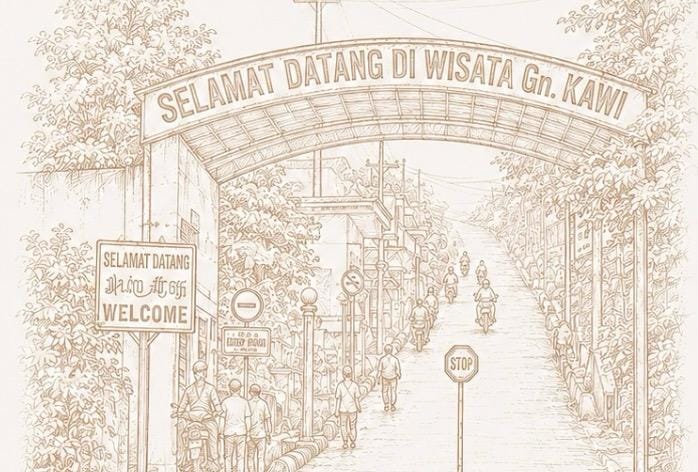
JAKARTA, Jakartaweekly.com — Since early morning, flower sellers have been arranging their offerings around the Gunung Kawi complex in Malang Regency. The scent of incense mingles with the fragrance of fresh flowers as pilgrims arrive one after another. Nearby, food stalls begin serving customers, guesthouses prepare to welcome tour groups, and small business owners hope the day will bring enough income to support their families.
For local residents, Gunung Kawi is far more than the burial site of revered historical figures. For decades, the area has served as the heartbeat of the local economy, sustaining countless families through pilgrimage, cultural tourism, culinary businesses, and traditional festivals held throughout the year.
Behind the bustling activity, however, lies an invisible challenge: the enduring stigma of pesugihan—a Javanese mystical practice believed to bring wealth through supernatural means. For decades, Gunung Kawi has been more widely known as a place associated with pesugihan than as a destination for religious pilgrimage and cultural tourism.
The perception has resurfaced in recent years as numerous social media posts portray Gunung Kawi as a place where people seek supernatural riches.
For the local community, the issue goes far beyond reputation. Residents worry that if Gunung Kawi continues to be viewed primarily as a pesugihan site, it will lose its appeal as a welcoming destination for families, pilgrims, and cultural travelers from diverse backgrounds.
Yet the local economy depends heavily on visitor arrivals. “The economic impact would be enormous because many small businesses rely on pilgrimage and tourism activities,” a representative of the Gunung Kawi Story community.
The community, which manages the Gunung Kawi Story Instagram account, said sensational stories about mysticism have consistently attracted more public attention than the site’s actual history and cultural heritage.
As a result, Gunung Kawi’s rich historical legacy has been overshadowed by supernatural narratives.
“The history and culture of Gunung Kawi, which are equally important, receive far less attention. The lack of alternative narratives has allowed the stigma to become deeply rooted and continue spreading,” the account administrator said.
In reality, they explained, people visit Gunung Kawi for many different reasons.
Some come to pay their respects at the graves of Eyang Djoego and Raden Mas Iman Soedjono. Others enjoy the area’s culinary offerings, hold selamatan thanksgiving ceremonies, or attend the many cultural festivals organized throughout the year.
The site also hosts a variety of cultural events, including the Selo Haul commemorating the death of Eyang Djoego, the 1 Suro Gunung Kawi celebration marking the Javanese New Year, the 12 Suro Haul honoring Raden Mas Iman Soedjono, and the Cap Go Meh Festival, which symbolizes the cultural blending of Javanese and Chinese traditions.
Many visitors simply come to enjoy the mountain scenery or visit houses of worship representing different religions located within the Gunung Kawi complex.
“Some visitors come purely to worship because the complex contains places of worship for various religions, while also enjoying its natural beauty,” the representative said.
Cultural observer and young puppeteer Henokh Aldebaran Ngili believes the stigma persists because some visitors do come with the hope of receiving blessings in the form of financial prosperity or the fulfillment of personal wishes.
Over time, he said, this has evolved into the widespread perception that Gunung Kawi is synonymous with pesugihan.
“Pesugihan can actually be practiced anywhere. In essence, Gunung Kawi is the sacred resting place of Eyang Djoego. Many people come on pilgrimage because they believe that spiritual devotion there can bring blessings,” Henokh told Jakarta Weekly.
Historically, Gunung Kawi is both the burial site and sacred memorial of Eyang Djoego, also known as Kyai Zakaria II, along with several other respected community figures.
During his lifetime, Eyang Djoego was known as a prominent figure who practiced the Javanese Islamic tradition. Owing to his charisma and influence, pilgrims from various religious backgrounds continue to visit the site to pray.
Henokh also rejected the assumption that the presence of flowers, incense, and ritual offerings constitutes evidence of mystical practices.
According to him, flowers and incense are merely symbolic elements used in many religions and cultural traditions. Their fragrance is believed to create a peaceful atmosphere that helps worshippers pray with greater focus and devotion.
The same applies to ritual offerings, known locally as caos dhahar. Each offering carries its own symbolic meaning, much like the Chinese tradition of preparing a deceased ancestor’s favorite foods as a sign of respect rather than as a means of acquiring supernatural powers.
Henokh acknowledged that ancient Javanese manuscripts do describe certain spiritual practices, including those related to pesugihan and ritual sacrifices. However, he stressed that the existence of such historical records cannot be used to conclude that Gunung Kawi is a center for pesugihan practices.
For the local community, this is precisely the narrative that needs to be corrected. While Gunung Kawi’s viral reputation as a pesugihan site has attracted more curious visitors, residents believe curiosity alone is not enough to sustain the area’s economy over the long term.
Rather than being known for its mystical image, they hope Gunung Kawi will be recognized as a destination for pilgrimage, cultural heritage, and tourism that generates sustainable economic benefits for the surrounding community.
Discover more